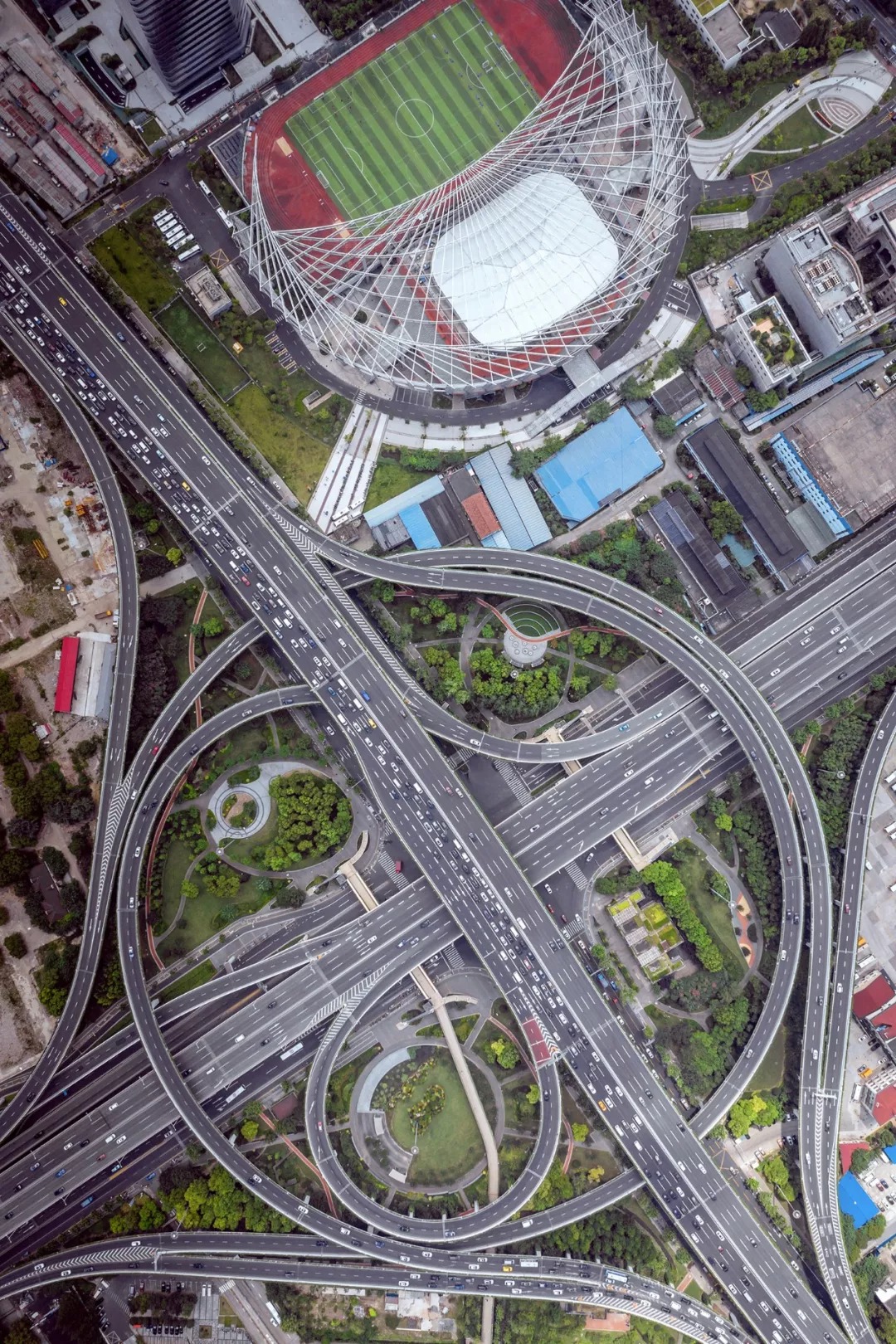
Original piece: 《立交桥交立交桥交立交桥交立交桥》
Produced by Institute for Planets (星球研究所) & 东风风神奕炫
Written by 桢公子
Translated by Kelvin Kwok
Posted with permission from Institute for Planets
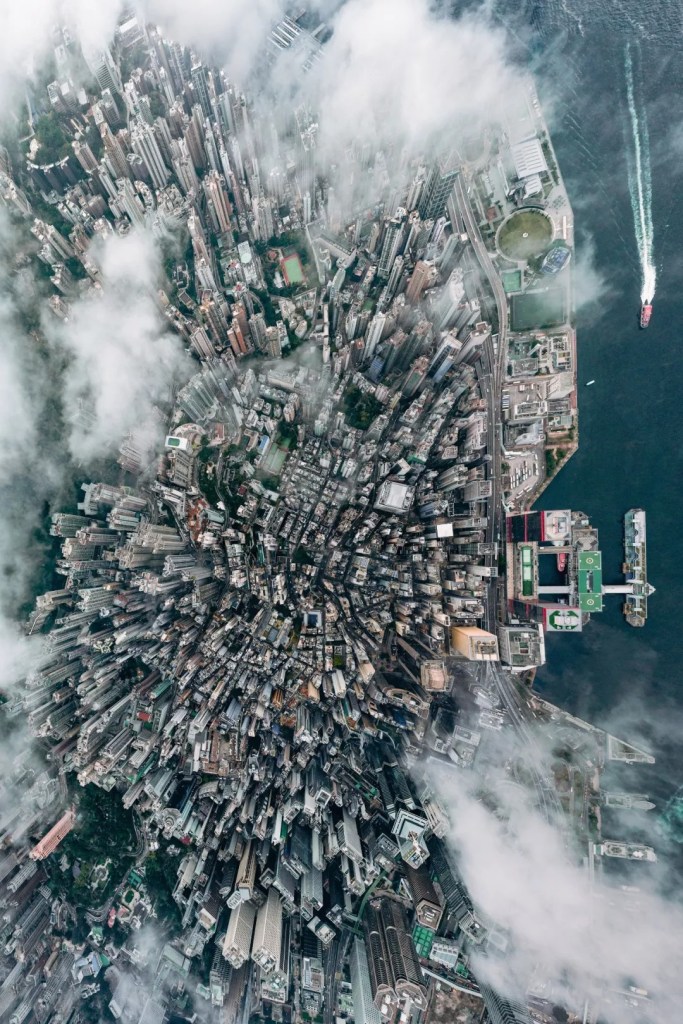
One does not need to observe too hard to realise that modern cities today have completely transitioned into the vertical space. This applies not only to the sky-scraping towers that cluster like a thick steel jungle…
(photo: 静言)
…but also to the roads that are abandoning the ground. They too are spreading out vertically while stacking on and weaving around one another.
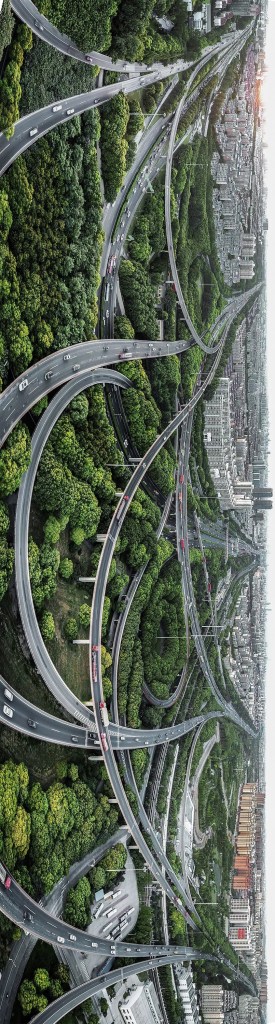
Only 5 ways are shown in the photo
(photo: 蔡震宇)
Orienteering within the vertical space has long become a daily routine for us. But if we change perspective and take another look at our city again from above, we will see something entirely different — an intricate yet mesmerising world of geometry.
So why did such complex structures emerge? And how were they built?
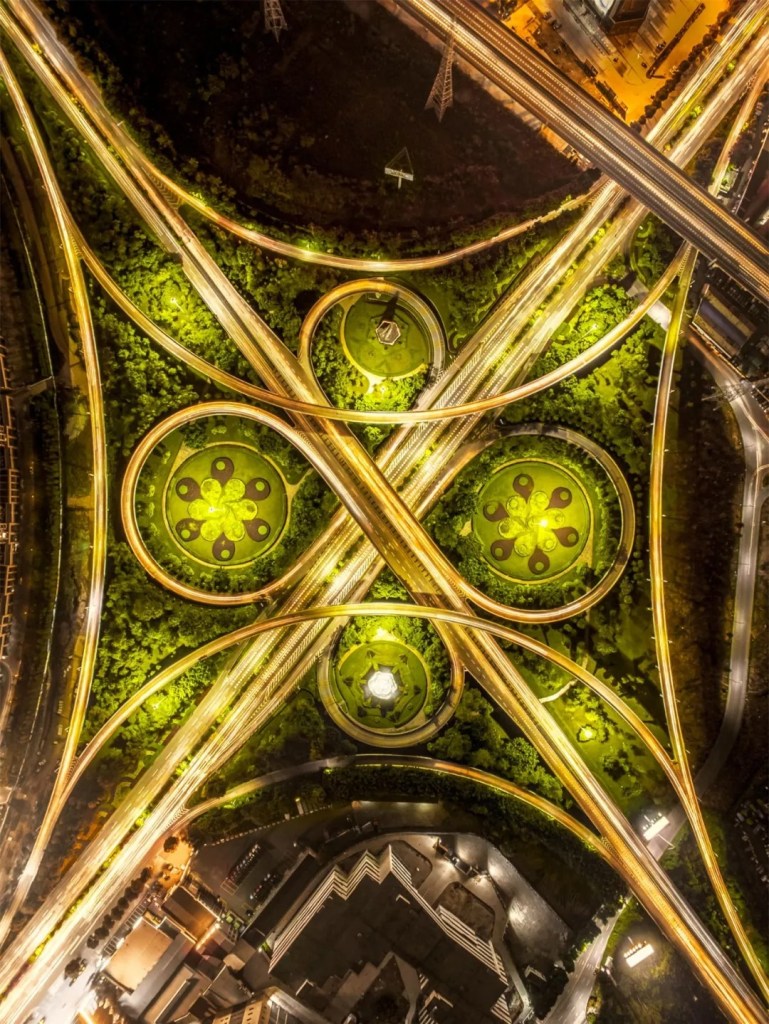
(photo: 梁文生)

Long-awaited solution to the ultimate problem
At a conventional four-leg intersection, there are 12 traffic movements possible, including 4 through and 8 turn manoeuvres. Here, diverging, merging and crossing give rise to 32 potential conflict points which, in case of increased traffic flow, are likely to cause jams or accidents.
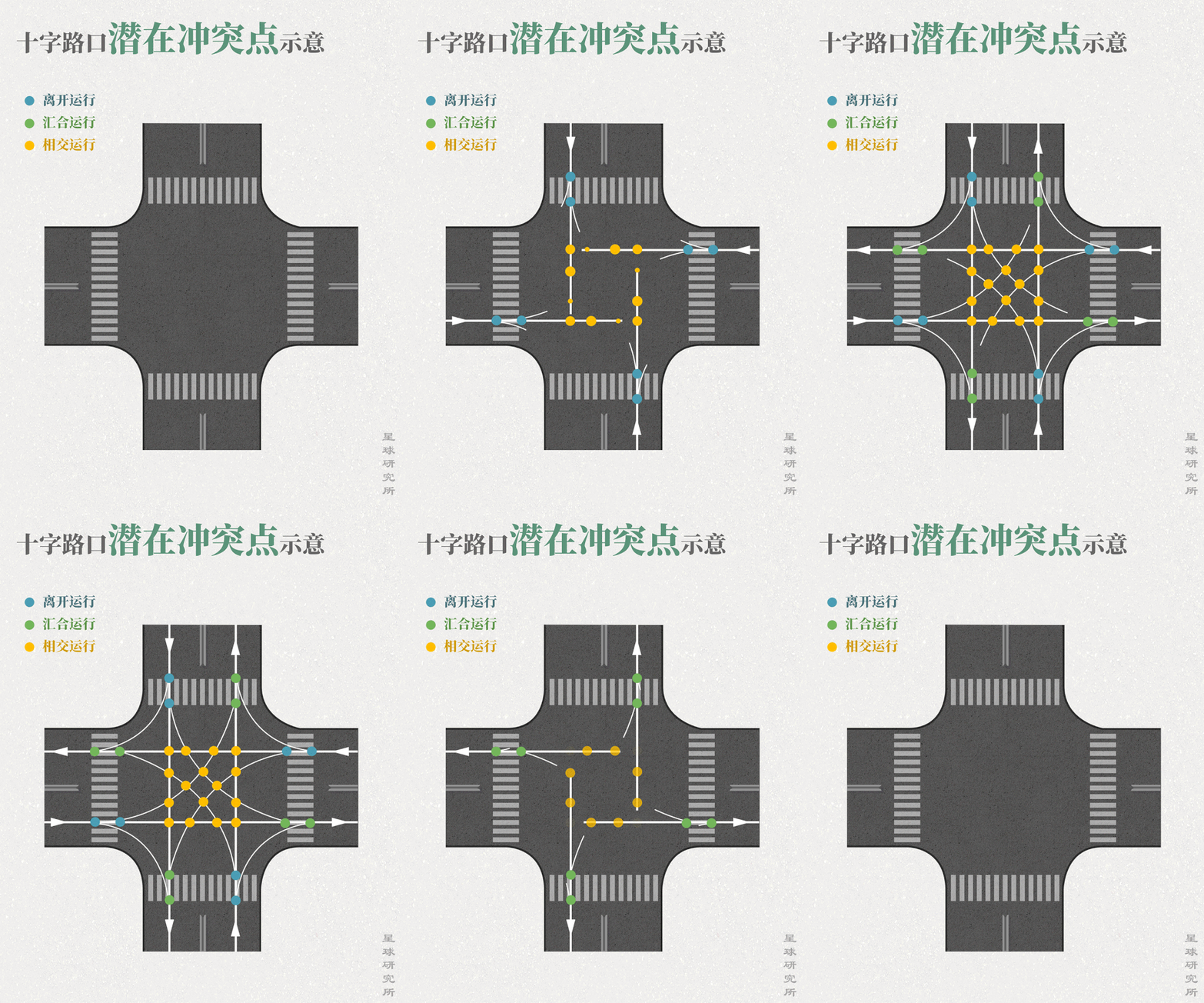
Diverging (离开运行), merging (汇合运行) and crossing manoeuvres (相交运行)
(diagram: 郑伯容&赵榜, Institute for Planets)
To minimise potential conflicts, intersections are signalised and ring roads are introduced, both of which serve to improve traffic flow and connectivity among each intersection leg. But these offer little help in the face of constantly increasing traffic volume, especially when it is accompanied by rapid development of highways and urban expressways. As the flow capacity of intersections approaches saturation, there is a pressing need for an innovative traffic configuration.
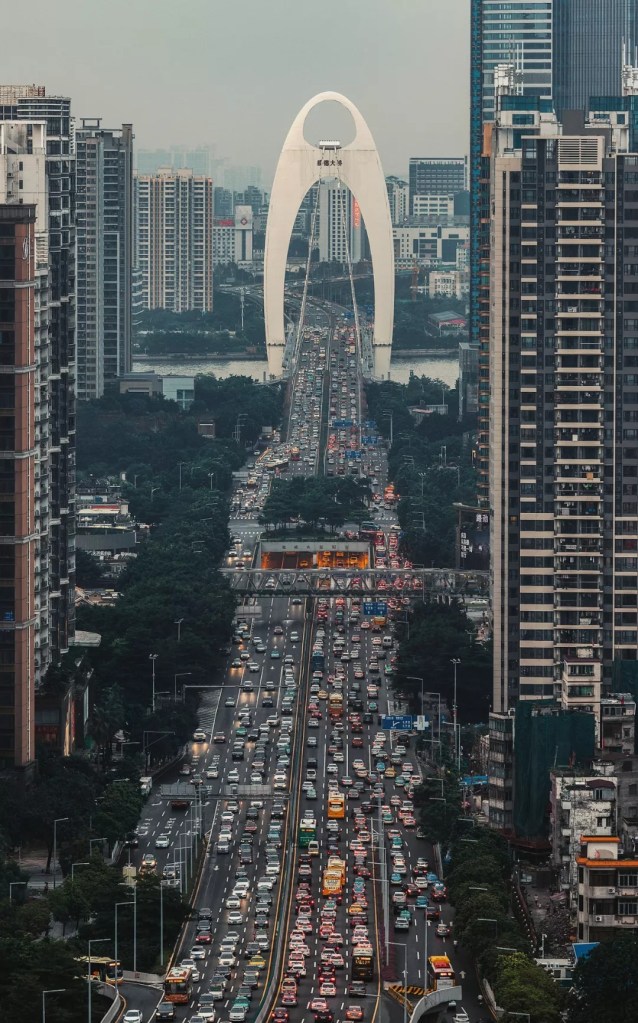
(photo: VCG)
So, crisscrossing roads on the ground are raised up into the air and segregated vertically. Intersections constituting roads running at separated grades are known as interchanges.
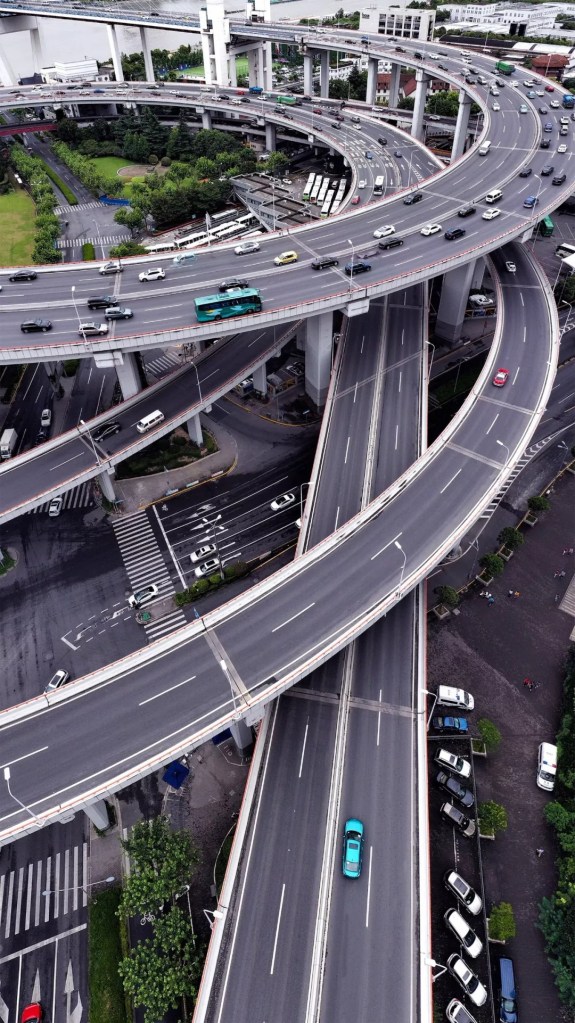
(photo: 东风风神奕炫)
At an interchange, lanes bifurcating from the positive line and designated for one-way turns are known as slip roads*
*Also known as ramps, depending on region
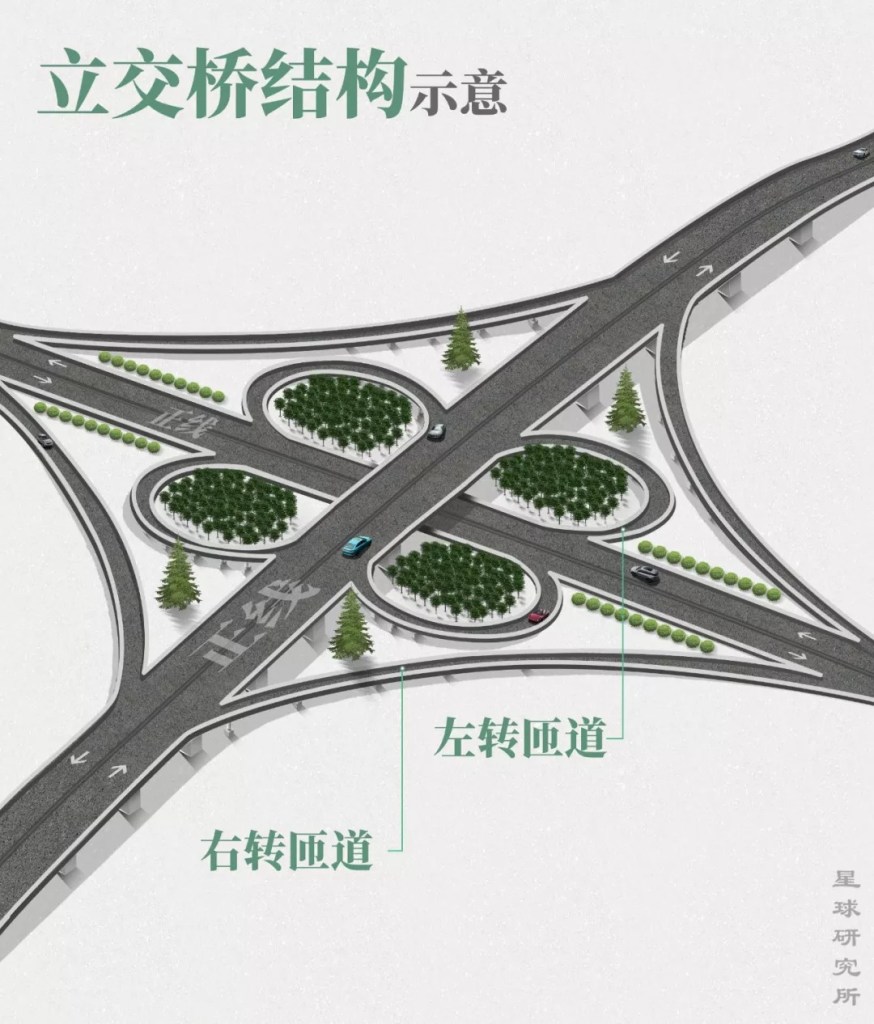
Positive line (正线), right-turning (右转匝道) and left-turning slip roads (左转匝道)
(diagram: 郑伯容, Institute for Planets)
For right-hand traffic, configuring the right-turning slip roads has always been straightforward and flexible, the real challenge is how to design an efficient left turn. That is the million-dollar question for interchange architects and builders.
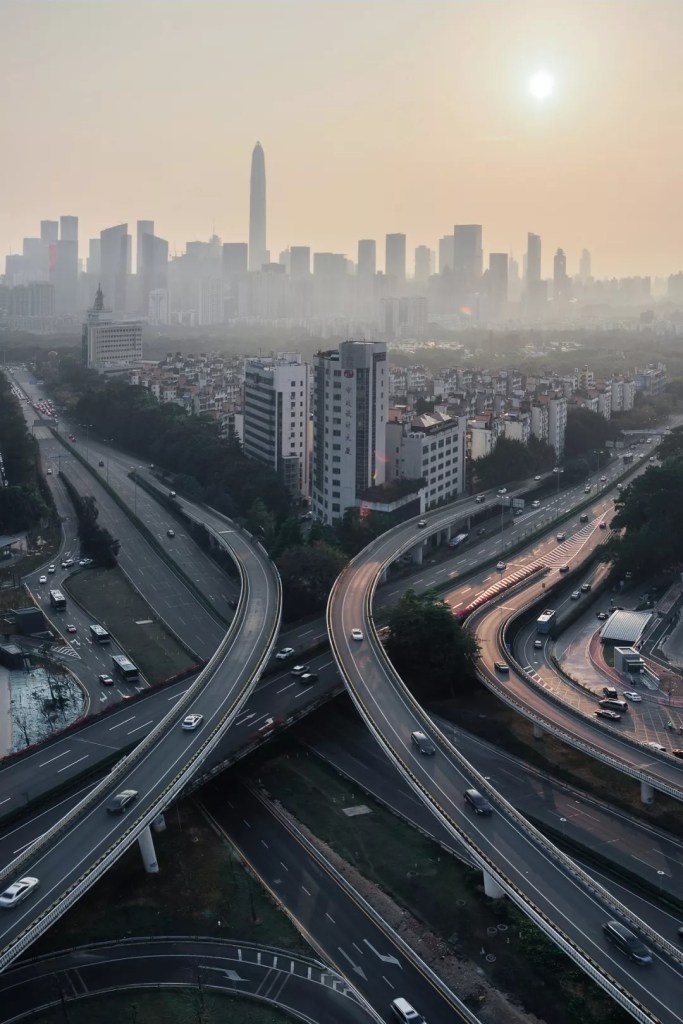
The two highest lanes crossing over the positive line are left-turning slip roads
(photo: 陈炜坚)
Back in the 1920s, Western countries started building loop slip roads at intersections, where vehicles have to exit on the right into a 270° loop to make a left turn. To allow movements in all directions, four loop and four right-turning slip roads are combined with two grade-separated positive lines (crossing highways) to form a unique four-way interchange commonly known as cloverleaf interchange.
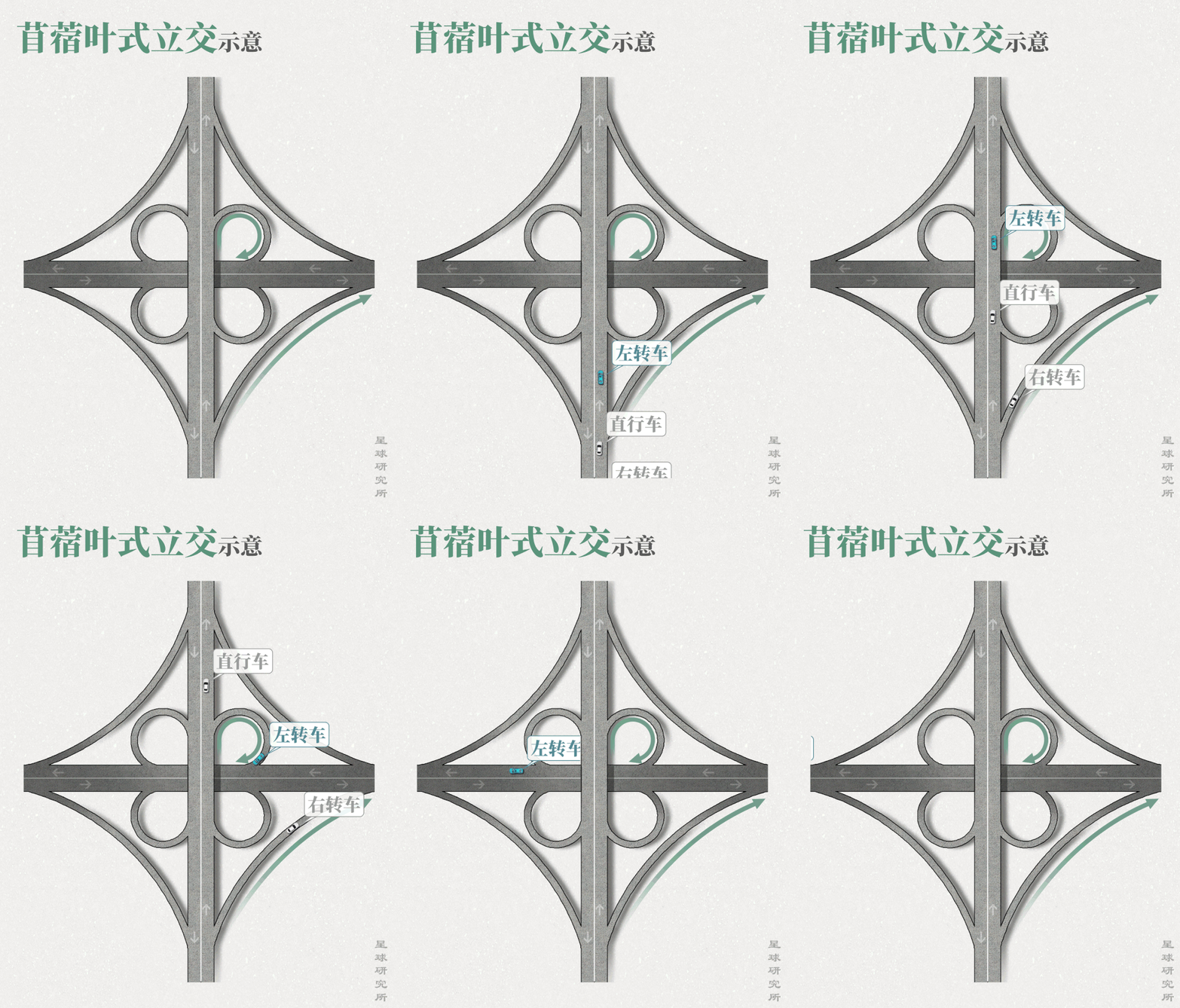
Through (直行车), left-turning (左转车) and right-turning vehicles (右转车)
(diagram: 郑伯容&陈思琦, Institute for Planets)
Since these perfectly symmetrical interchanges are free of intertwined roads and require only one bridge, building one is relatively simple and economical. They are widely used in the world and also within China, despite only being introduced almost half a century later in the latter.
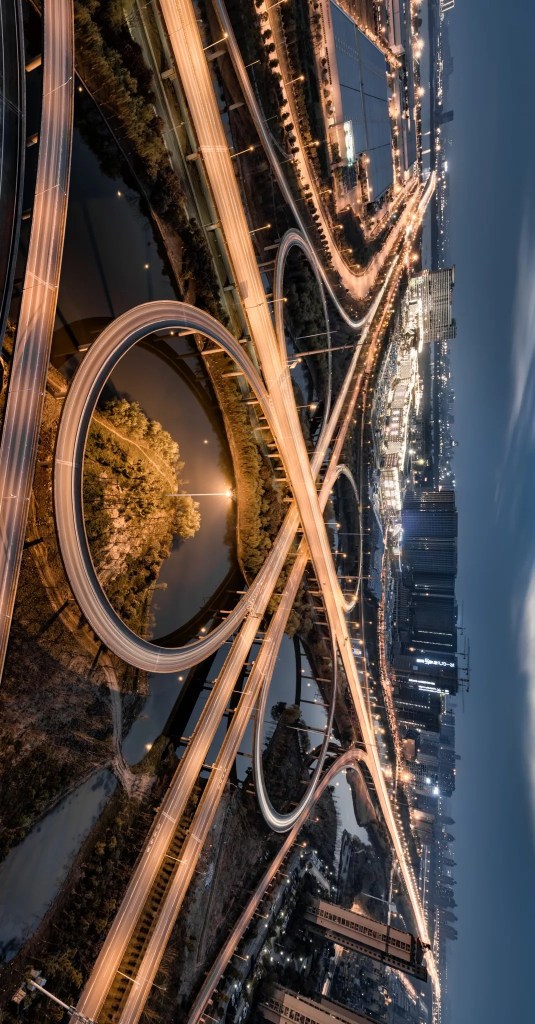
(photo: 高照)
But this design is still far from perfect, and one of the biggest problems is the weaving issue. It happens when vehicles merging into the positive line want to keep to the left while those veering out are trying to keep to the right, which forces them to cross path within a short distance and greatly impacts on traffic movement and safety on the positive line.
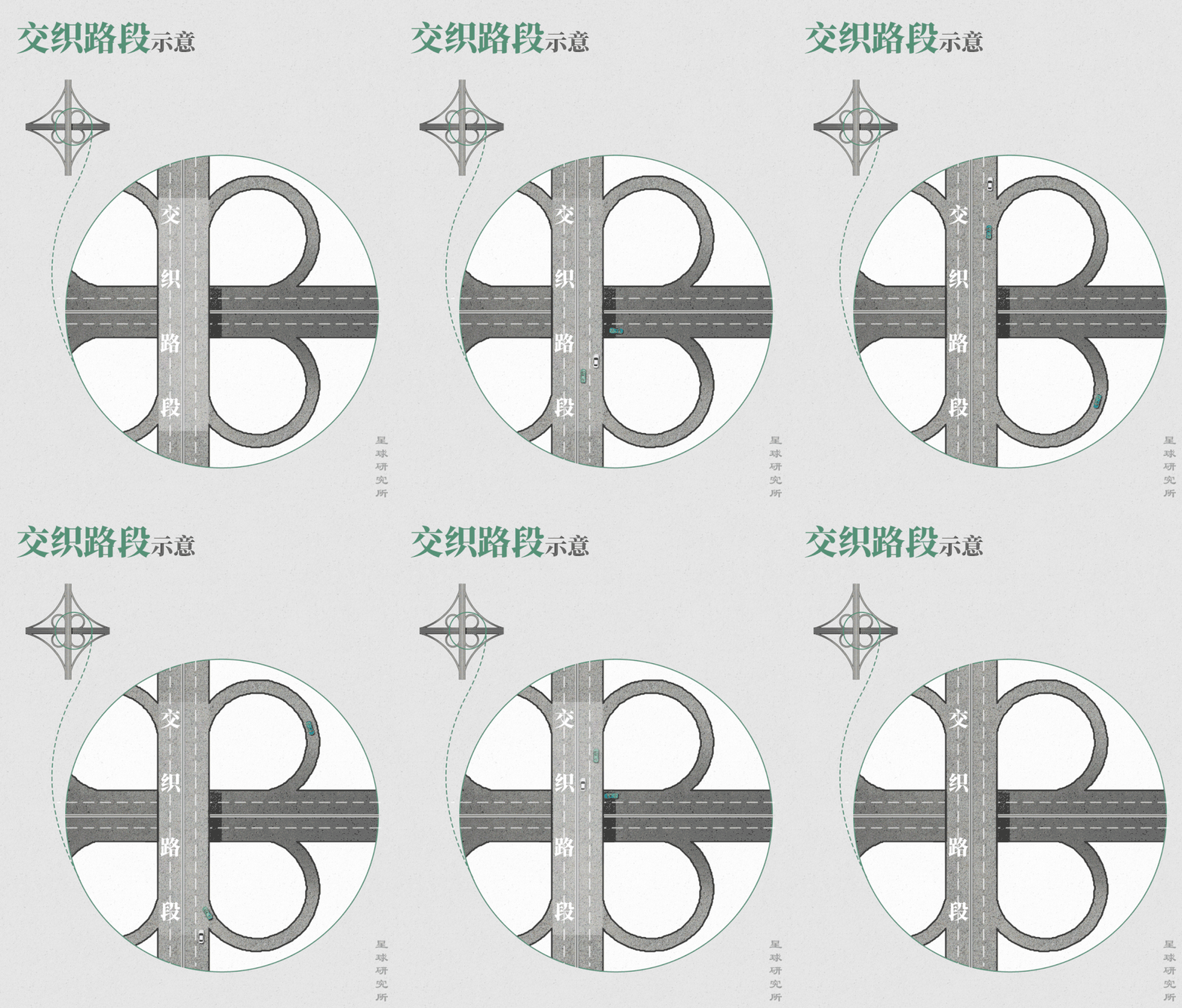
(diagram: 郑伯容&陈思琦, Institute for Planets)
In order to solve this, engineers designed the collector-distributor lane which separates the weaving section from the positive line and ensures a smooth traffic flow for through vehicles.
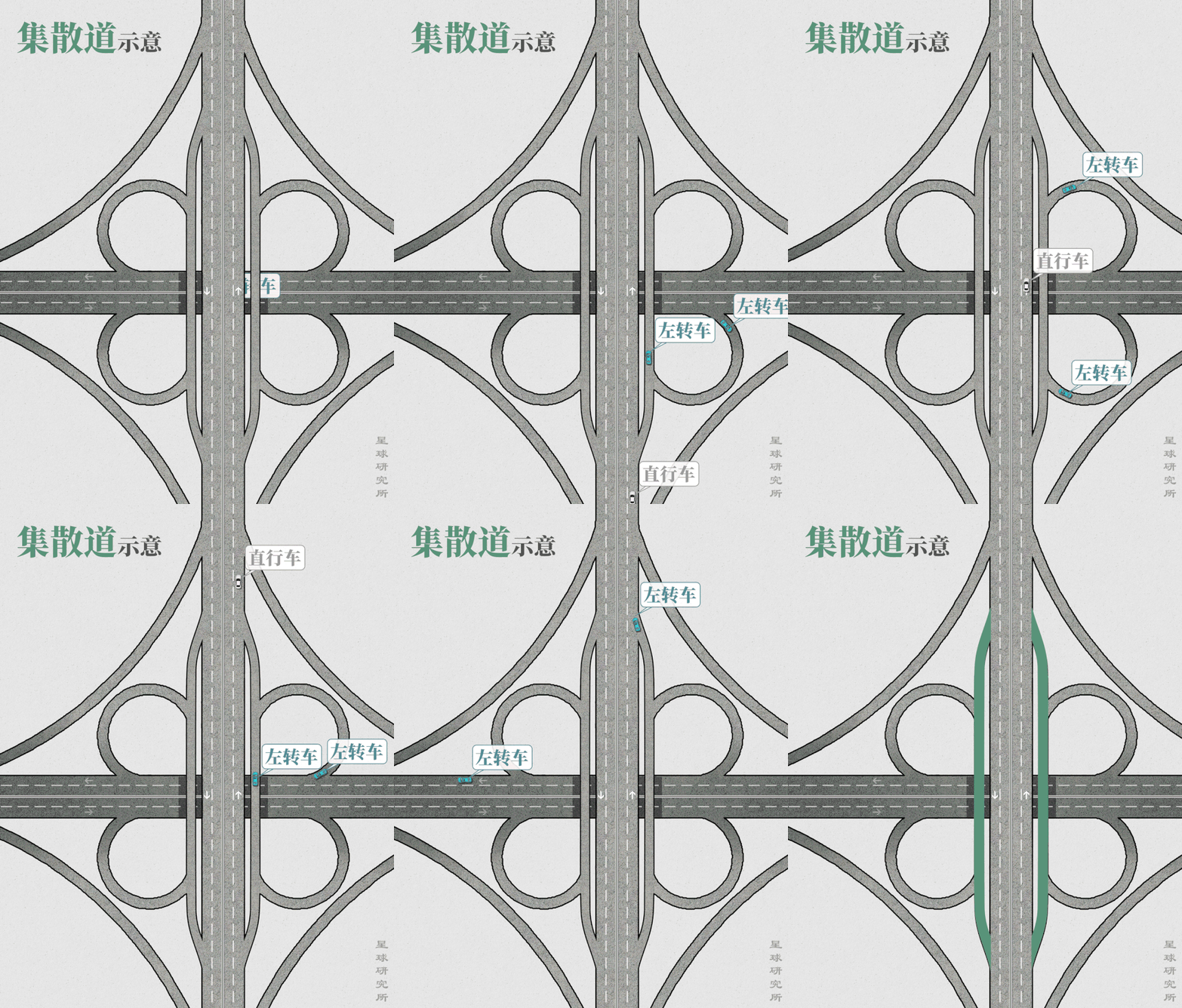
(diagram: 郑伯容&陈思琦, Institute for Planets)
To maintain traffic speed and safety at a cloverleaf interchange, the loop slip roads need a radius large enough so that the turns are not too sharp. This implies substantial land use, and adding collector-distributor lanes will surely complicates things.
Usually, a cloverleaf interchange takes up about 70,000 to 90,000 square metres of space, which is about the size of 10 standard football fields combined. But in a densely populated city where every inch of land matters, land use for interchanges have to be minimised, for example by compressing the loop slip roads and making them longer and thinner.
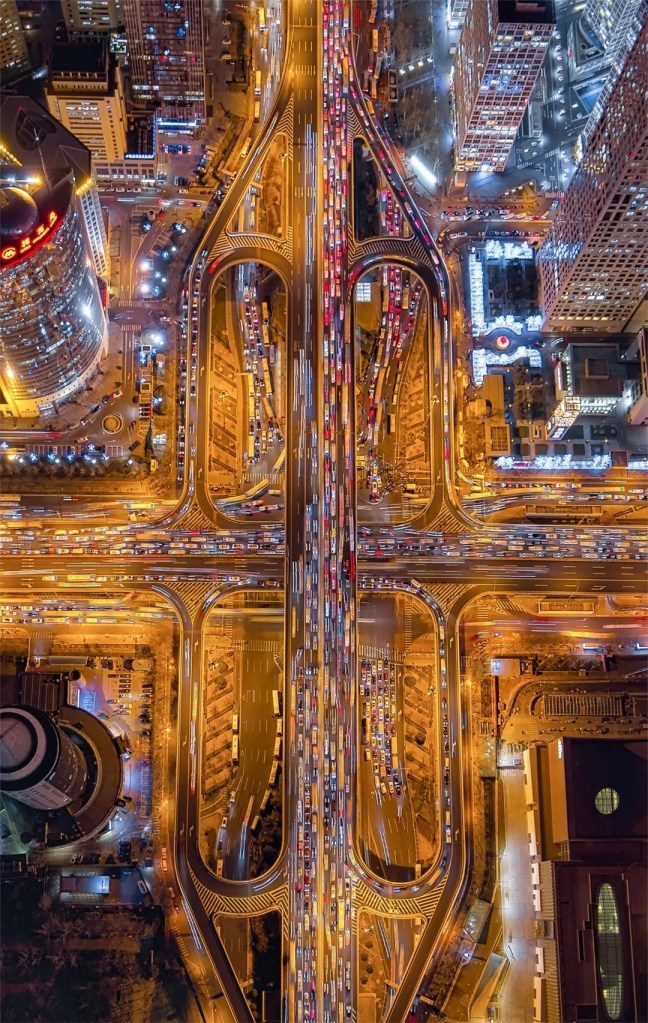
Flattened cloverleaf interchanges are very common in crowded cities
(photo: 李子韬)
Conversely, the loops can be replaced by another left-turning model, such as that in a diamond interchange. This relatively crude model completely abandons all loop slip roads, and lets the minor line at the junction manage all left turns.
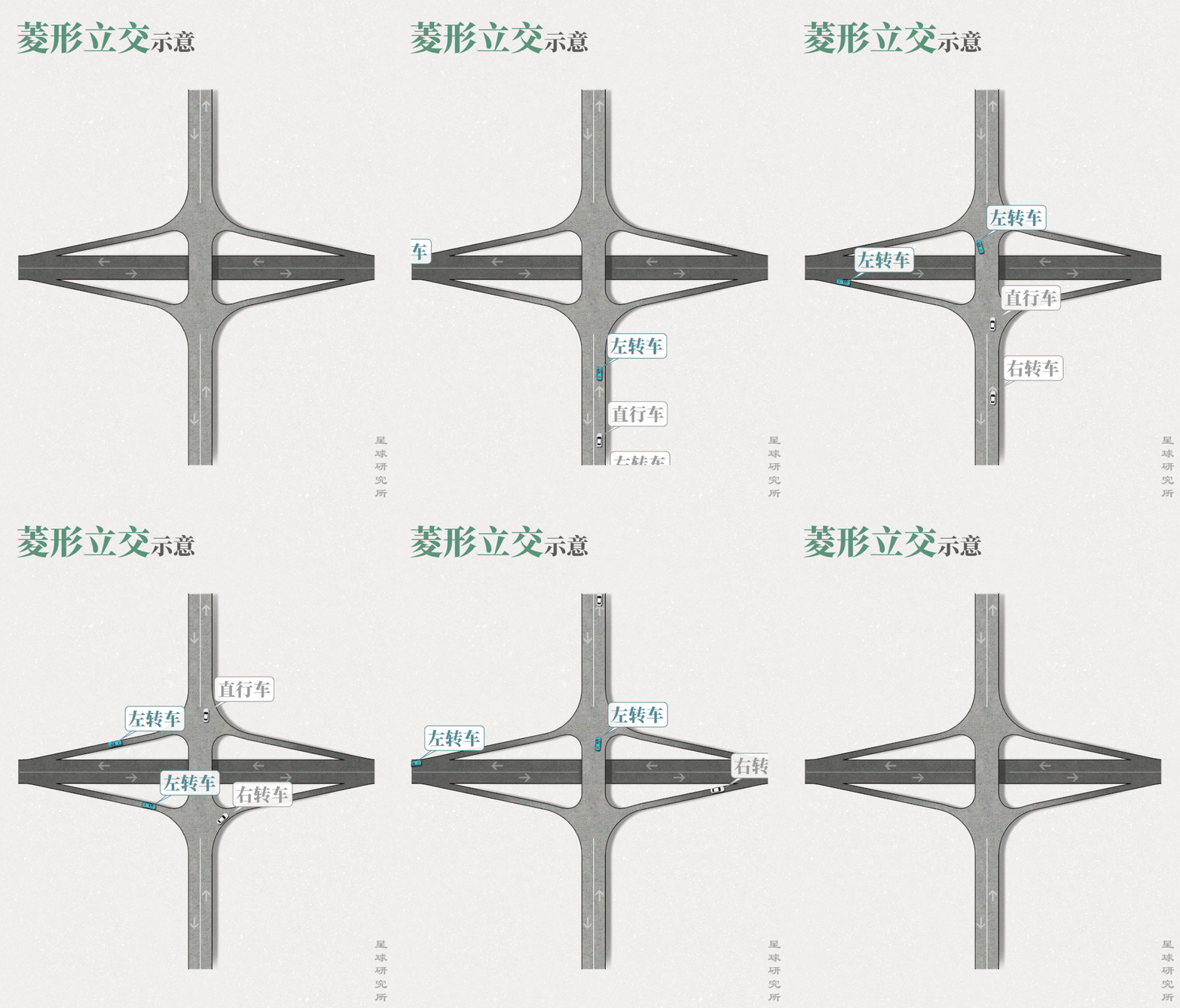
Regarded as an incomplete interchange, it is predominantly used for mixed intersections, e.g. intersection of an urban expressway and an ordinary main road
(diagram: 郑伯容&陈思琦, Institute for Planets)
Since only the right-turning slip roads are configured, diamond interchanges can adopt more flexible forms. They mostly occupy only about a third of the area required for cloverleaf interchanges.
Though cloverleaf and diamond interchanges both seem to provide a feasible solution to the left-turn conundrum, neither of them can avoid weaving completely. Further improvement in interchange traffic efficiency will require a design upgrade, and this shall be achieved through various permutations of slip road models.

Power of permutations
In practice, there are 10 available choices for left-turning slip roads (#1-10), including the two types introduced above. Given standard interchanges contain four slip roads, that gives us as many as 104 permutations of interchange configuration. Even when some permutations are stringently eliminated owing to impractical appearance, there are still 172 of them to choose from.
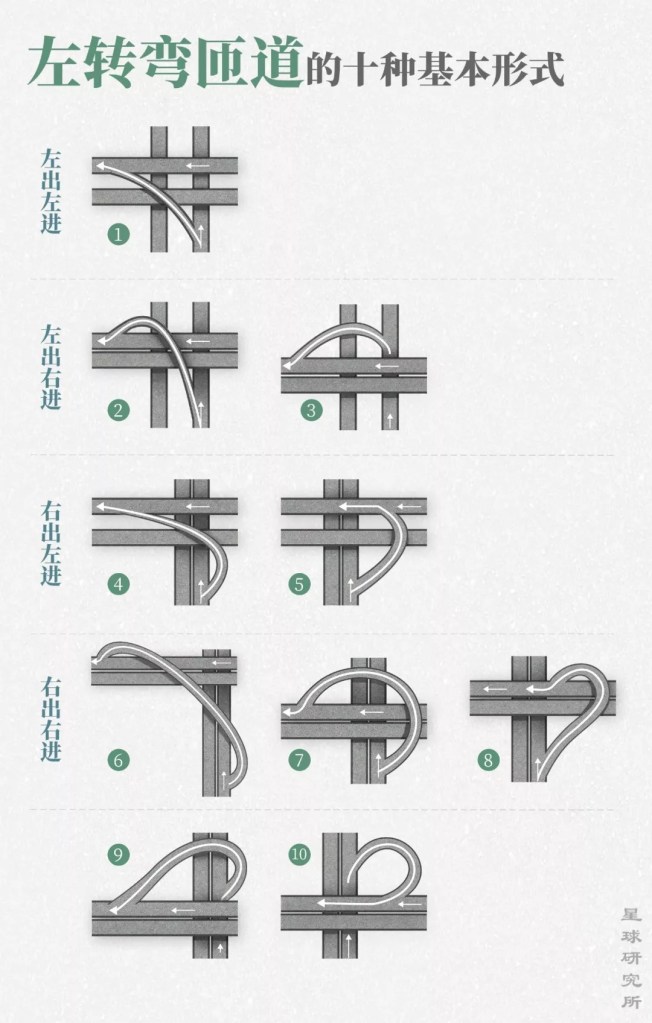
In reality, feasible permutations are much fewer than 172
#1 is direct slip road, #2-9 are semi-direct slip road, #10 is indirect slip road
Exit-left-enter-left (左出左进), exit-left-enter-right (左出右进), exit-right-enter-left (右出右进), exit-right-enter-right (右出左进)
(diagram: 郑伯容, Institute for Planets)
Compared to the oblique route of #10, which takes a 270° right to achieve a left turn, #1-9 are relatively straight to the point. When cooperating in various permutations, they create a rich assortment of interchange forms.
For example, when four #6 come together, they form the so-called X-interchange.
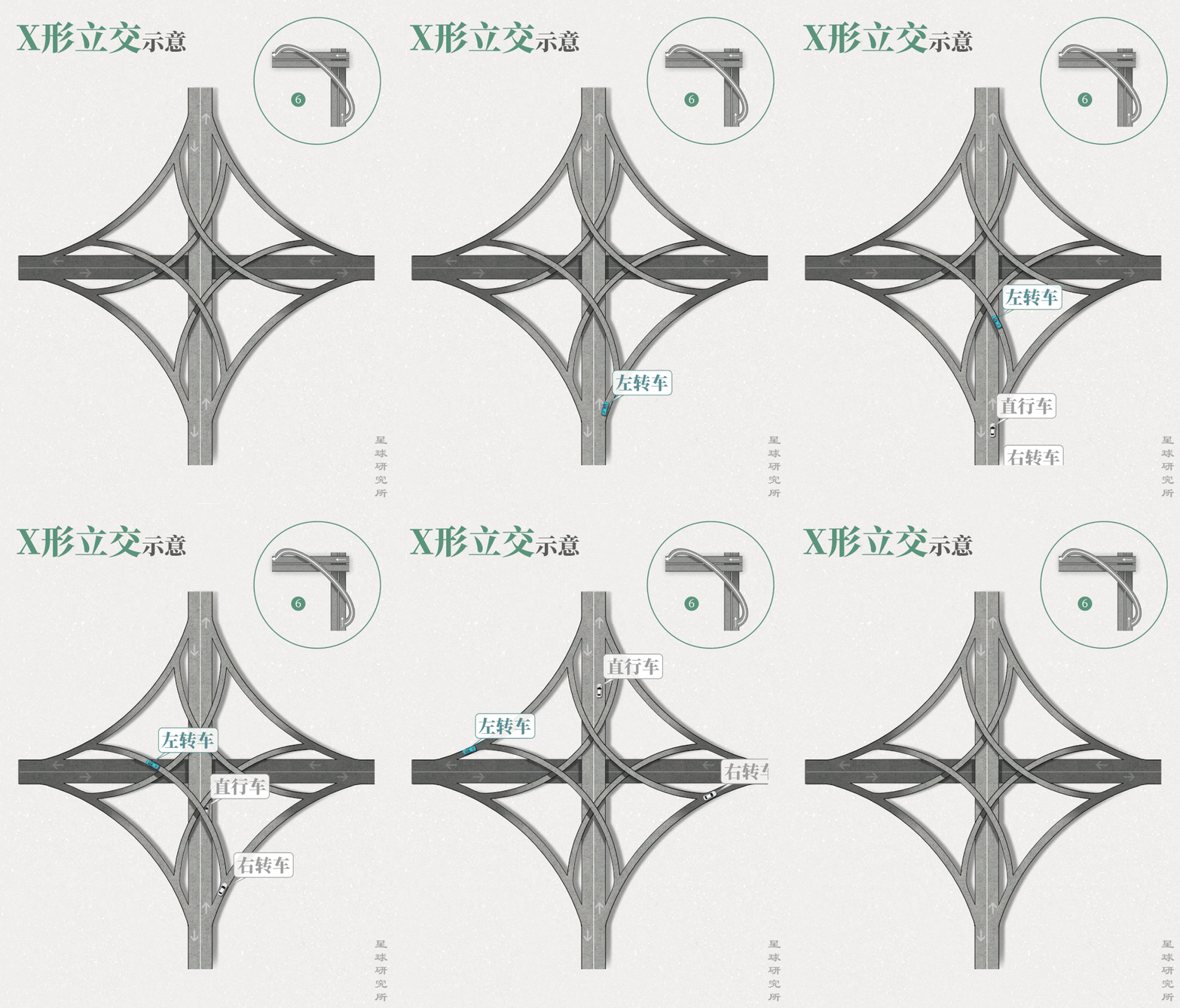
(diagram: 郑伯容&陈思琦, Institute for Planets)
All left-turning slip roads now break off from the positive line on the right and merge with the perpendicular positive line from the right. This makes driving much smoother and safer.
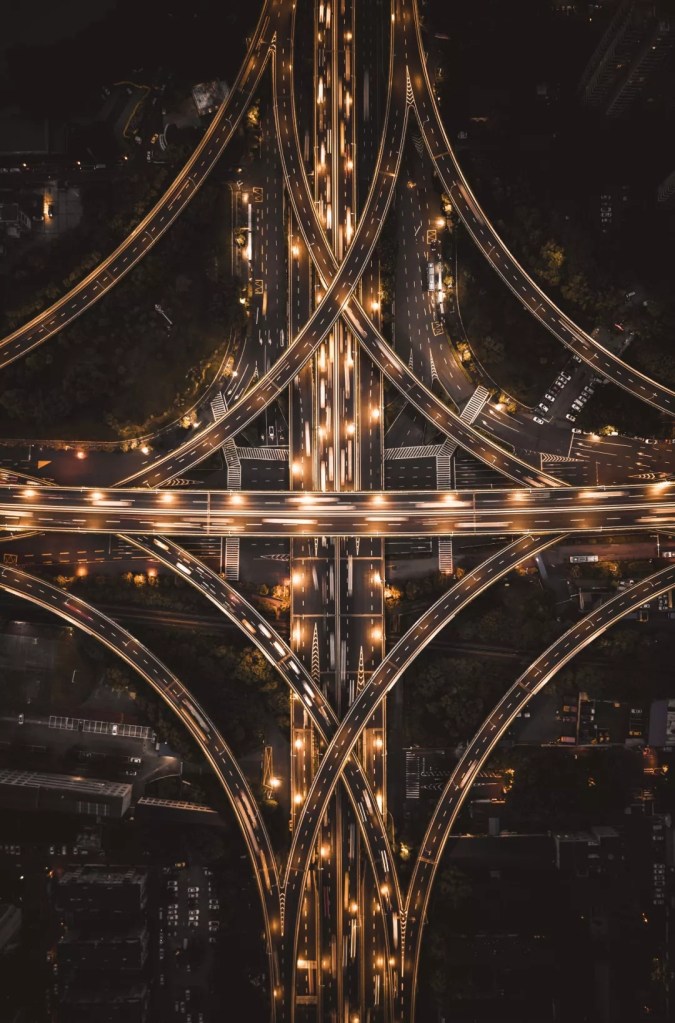
An example of X-interchange
(photo: 方飞)
But a major drawback of X-interchanges is that the slip roads have to cross over two positive lines within a short distance. This requires multiple grades and long bridges, and hence high costs to build. One way is to cut down the bridge span, all the way until the intersection point of the four slip roads is overlapping with that of the two positive lines, thereby forming a four-point star interchange.

(diagram: 郑伯容&陈思琦, Institute for Planets)
The structure of this interchange is particularly regular and symmetrical. It allows smoother turns without frequent deceleration and further boosts traffic efficiency.
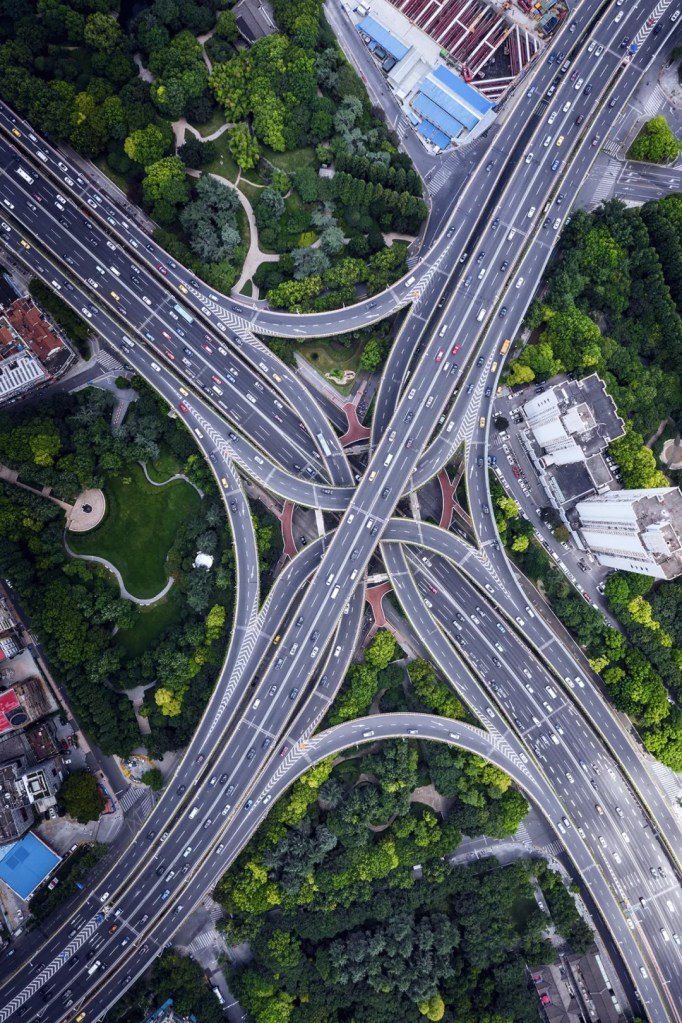
An example of four-point star interchange
This is where Yan-an Elevated Road and North-South Elevated Road intersect
(photo: 吕威)
But due to drivers’ insatiable desire for even higher speed, builders have to come up with something better still. By putting four #7 slip roads together, they expand the length of the loops to create the turbine interchange.
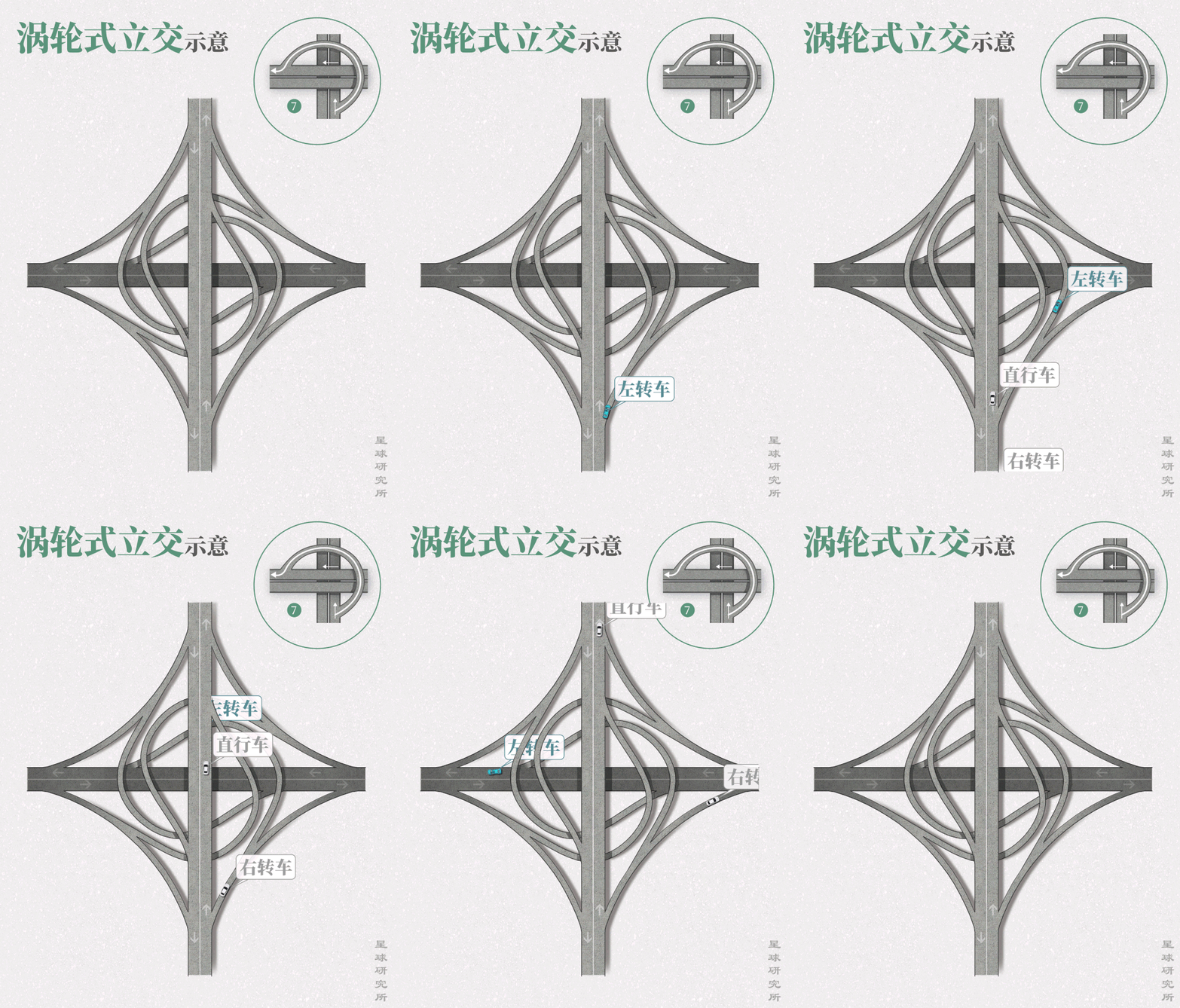
(diagram: 郑伯容&陈思琦, Institute for Planets)
It has a grand appearance and gradual climbs for safe and high speed traffic.
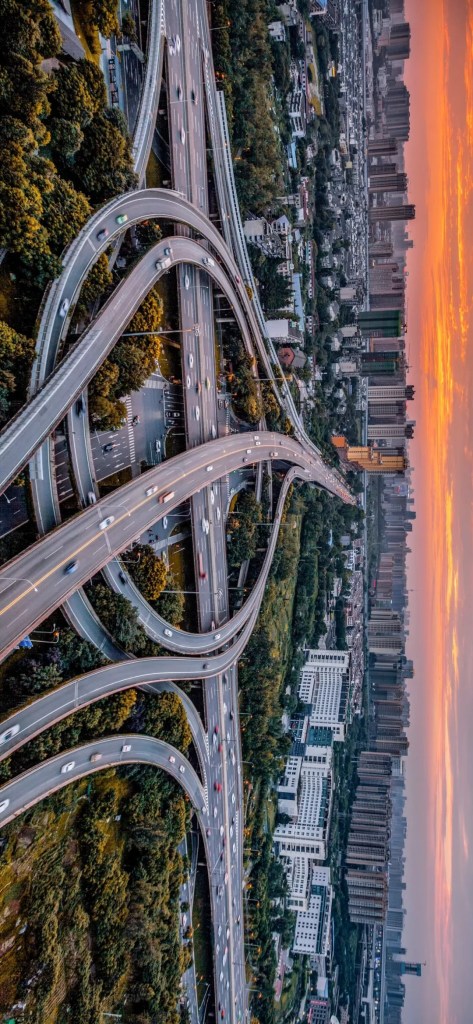
An example of turbine interchange
(photo: 蒋小翼)
But these come with considerable downsides. The enhanced traffic efficiency is achieved at the expense of construction complexity and cost. On these interchanges, positive lines and slip roads crisscross with and stack over one another.
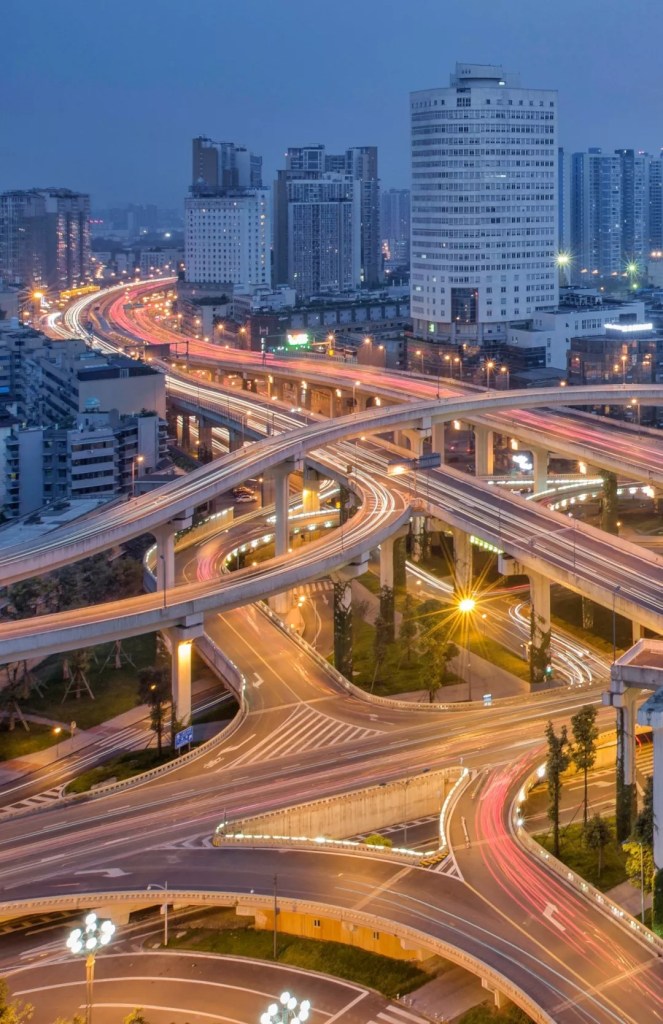
Roads are vertically separated into four grades
(photo: 唐侨)
The East Yan’an Road Interchange, for instance, are separated into a total of 5 grades in the vertical space. The massive bridge pier standing at the centre is 5 metres wide and 32 metres tall. Decorated with a golden dragon coiling around its body, the pier looks like a divine pillar holding up the sky (一柱擎天).
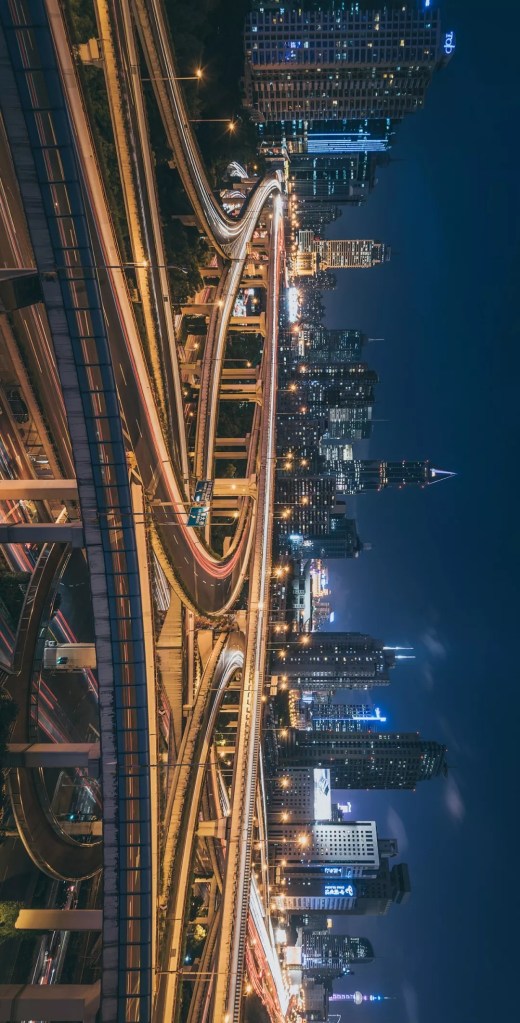
The tallest pier in the centre is the coiling dragon pillar that supports the South-North Elevated Road
(photo: 尼古拉斯张)
While turbine interchanges maintain a high traffic speed, the longer travel on the loop slip roads is almost like a detour for vehicles, and at least five bridges are needed to support all components, which are expensive to build.
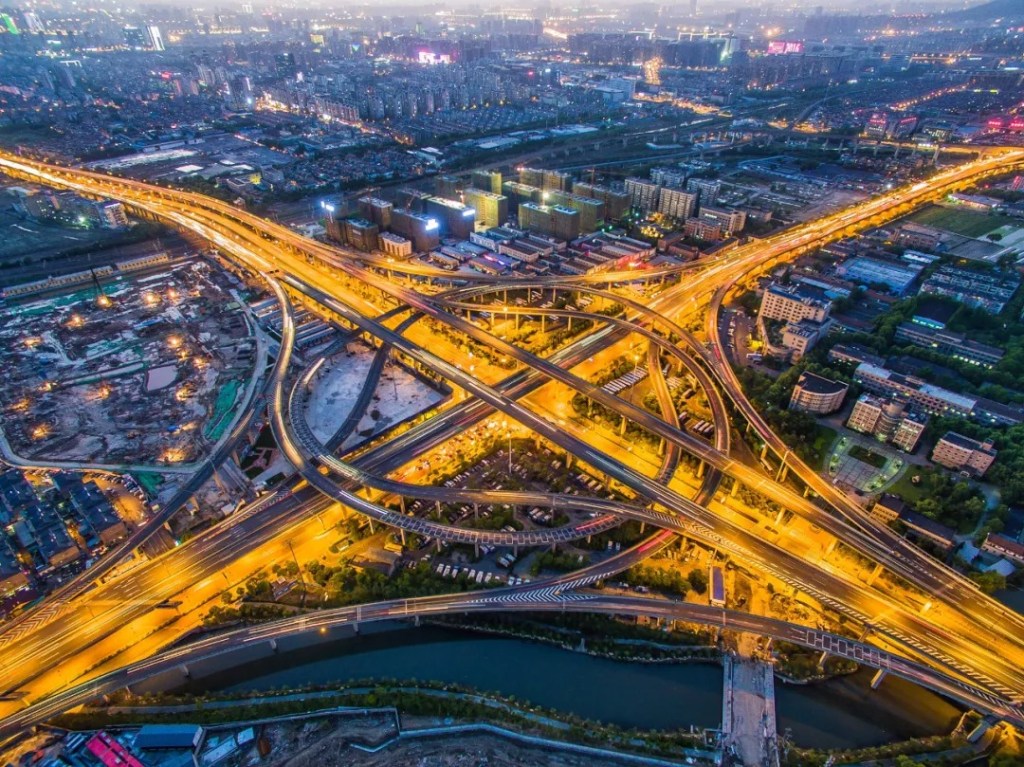
An example for turbine interchange
(photo: 张力)
Worry not. The geometric world created by different permutations of slip road design is much more exuberant than those listed above. Even just copying and pasting the same slip road type is sufficient to yield many more regular and symmetrical structures, including three-way interchanges, as exemplified by full and semi-Y-interchanges.
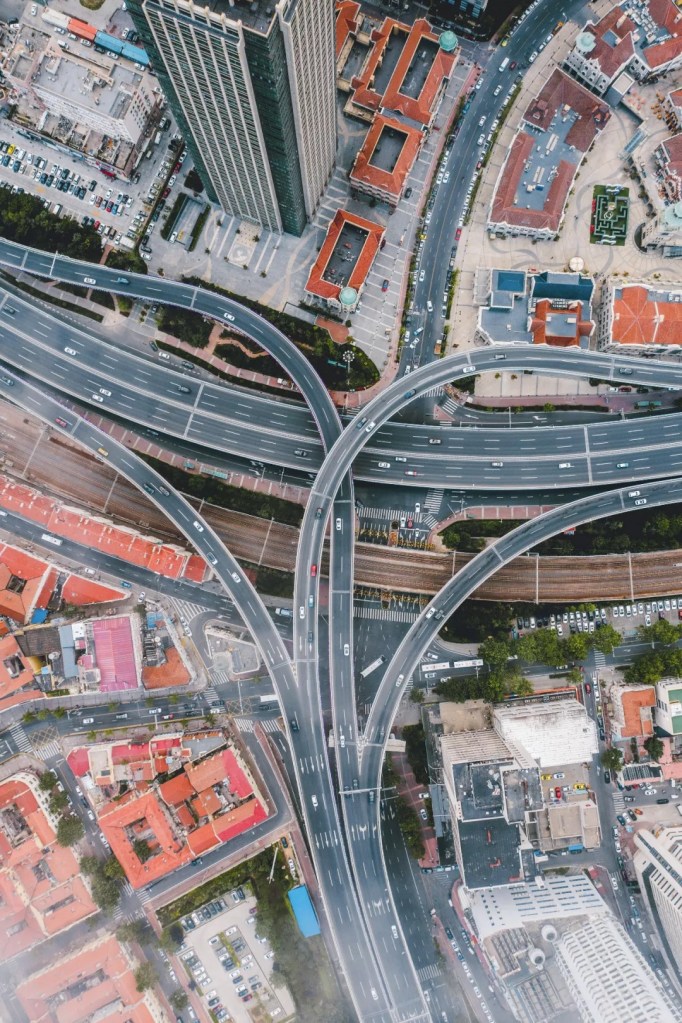
An example of full Y-interchange consisting of two #2 slip roads; semi-Y-interchanges on the other hand consist of two #1 slip roads
(photo: wenidon)
Different slip road types can also team up. When elegantly put together by skilful engineers, the resulting interchanges are always the most striking beauty in town.
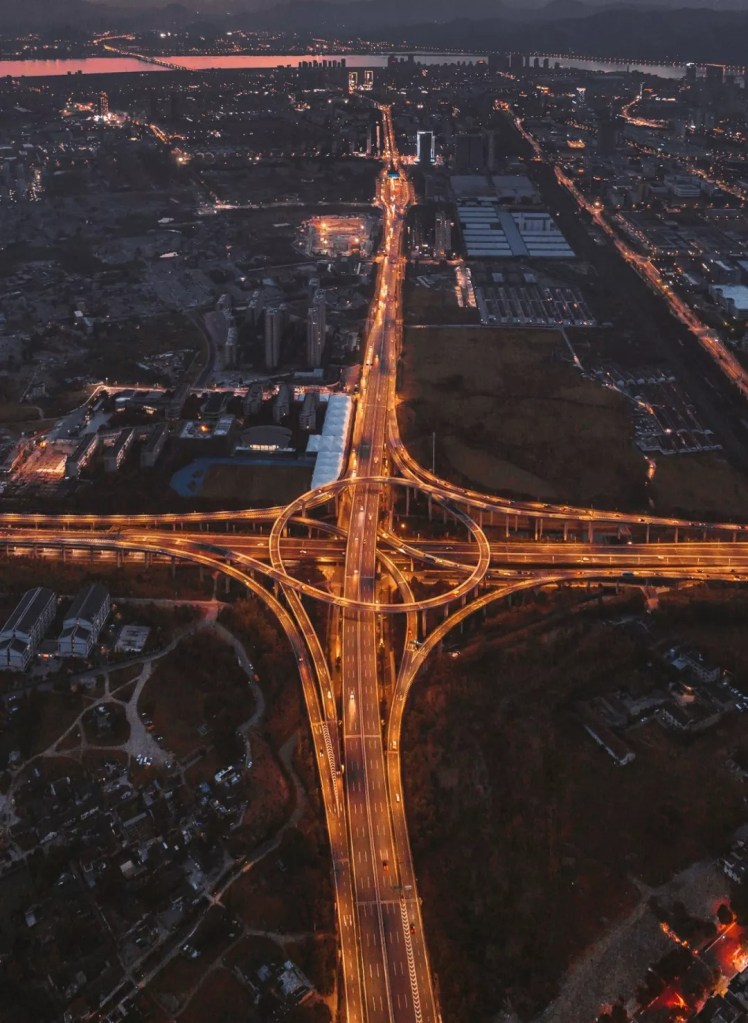
It is comprised of two #6 and two #7 slip roads
(photo: 张力)
Unfortunately, no matter how efficient and pretty these interchanges are, their construction will always be limited by land use and costs. Engineers therefore have to make tough decisions and realistic compromises based on available choices, much like a dancer performing the best moves possible with cuffed legs.

Dancing with cuffed legs
Because of that, in reality, it is not uncommon to see inconsistent configuration of left-turning slip roads within one interchange, in other words a combination of loop and other slip road types. In some cases, one of the loop slip roads in a cloverleaf interchange is replaced by direct or semi-direct slip road.
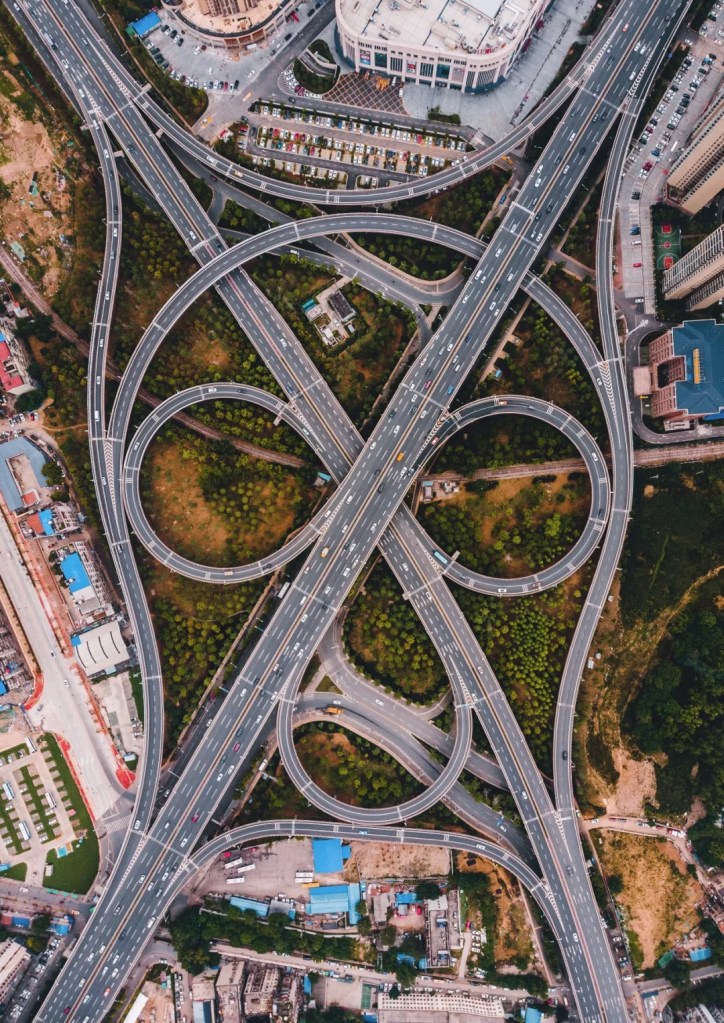
An example of cloverleaf interchange where one of the slip roads is replaced by a #7 type, imitating the classic alien face
(photo: wenidon)
Some take the opposite approach, that is to replace one of the direct or semi-direct slip roads with a cloverleaf.
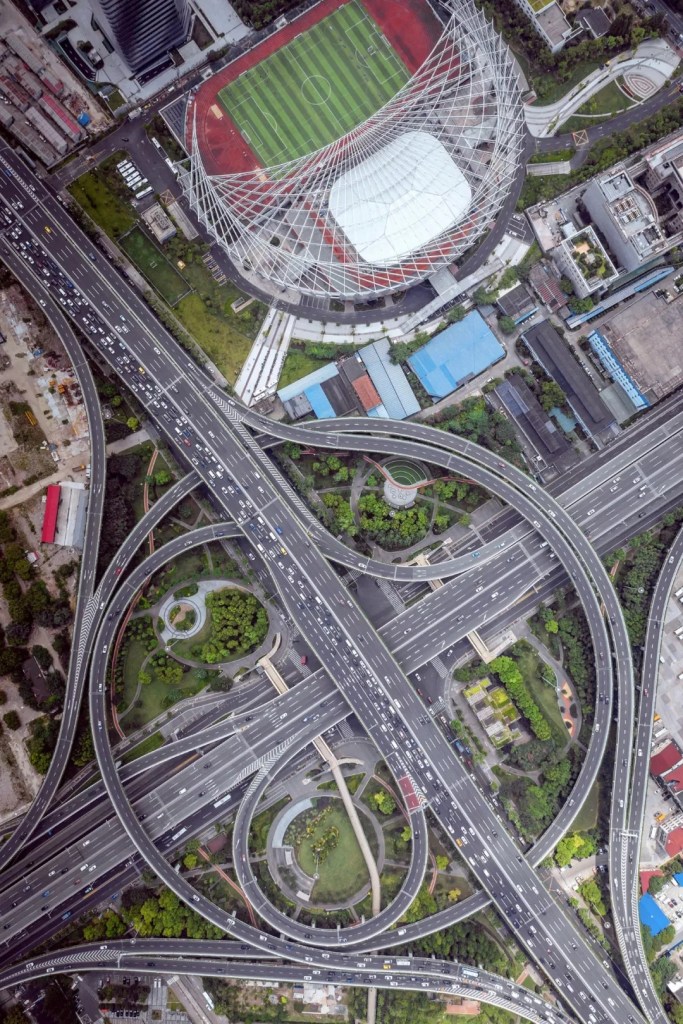
An example of turbine interchange where one slip road is replaced with a loop
(photo: 吕威)
Others may even give up on one of the less demanded traffic movements and be content with a semi-interchange.

There is no turning left from the top-right positive line to the bottom-right positive line
(photo: 高照)
If these interchanges look slightly incomplete to perfectionists, then the semi-cloverleaf interchanges which retain two leaflets may be considered to make up for the missing symmetry.
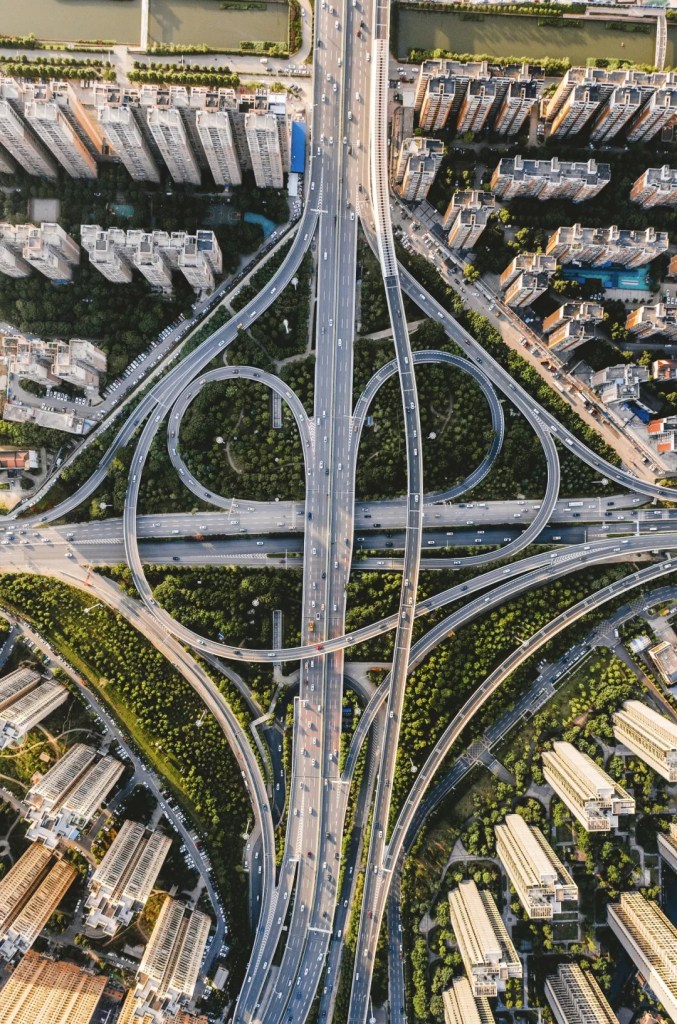
It consists of two loop and two #7 slip roads
(photo: wenidon)
When the construction space is limited to one side of the positive line by river channels, railways or residential areas, two of the loop slip roads can be juxtaposed on the same side as a pair.
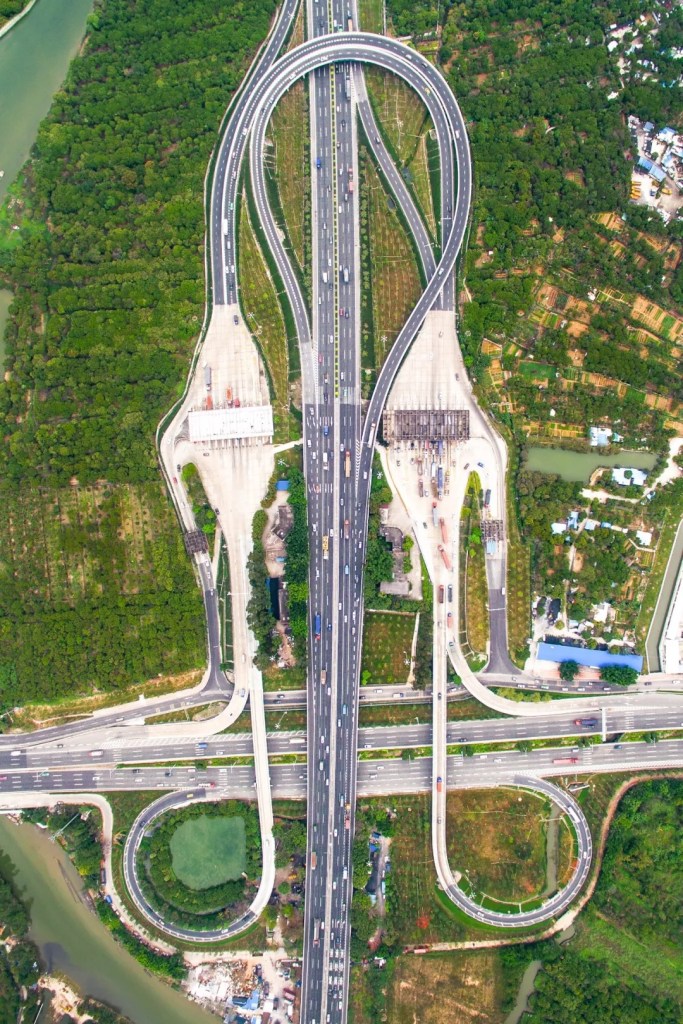
Tollbooths are the major limiting factor in this case
This interchange type can also be used if each direction has different demand for traffic efficiency
(photo: 梁文生)
Similar to cloverleaf interchanges, pairing up two loop slip roads may lead to weaving, and hence requires collector-distributor lanes. On the contrary, placing them diagonally not only avoids weaving, but also preserves symmetry. More importantly, the flattened design is more suited for narrow space.
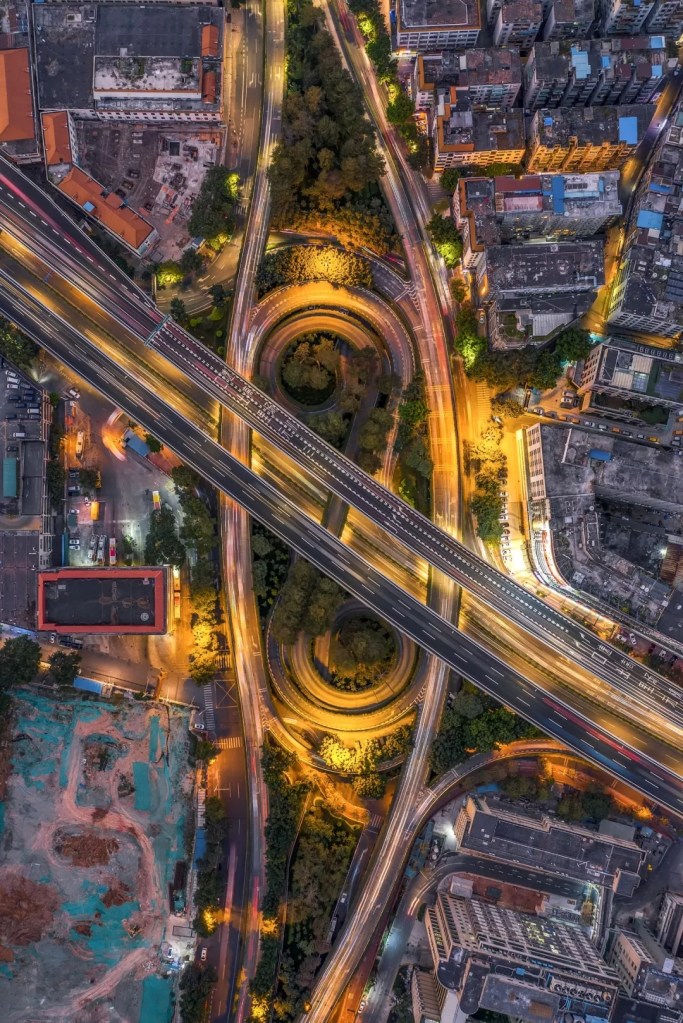
(photo: Patrick wong)
For example, combining #6 slip roads with two diagonally placed leaflets will create a sandglass-like interchange with a slim waist.
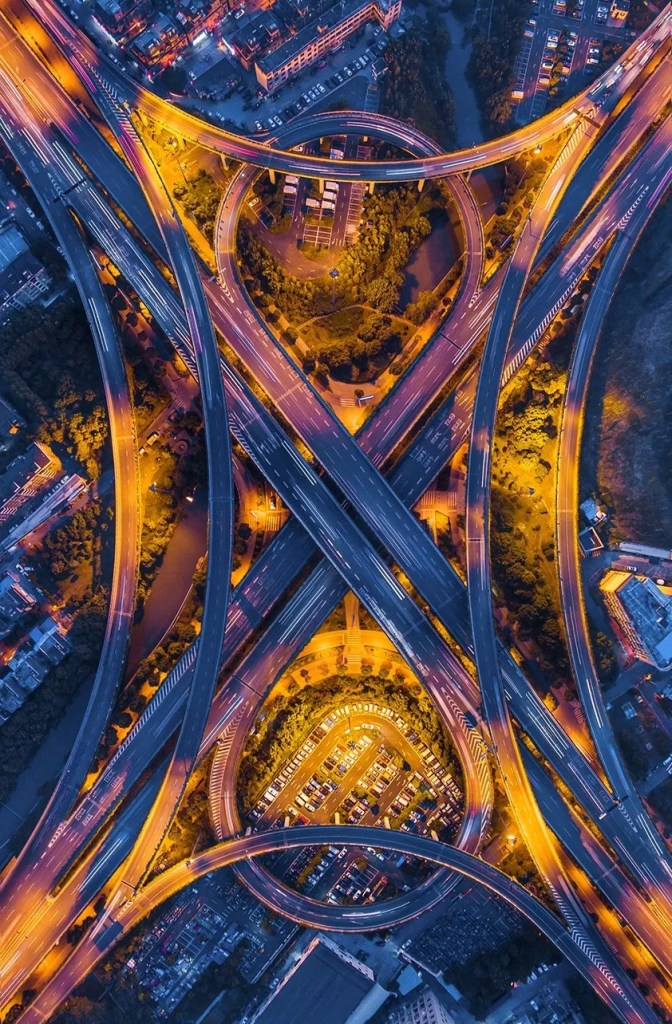
The two leaves are accompanied by two #6 slip roads on each side
(photo: 张力)
And when they team up with #7 slip roads, the beauty of geometry will be further unleashed. Depending on the way they loop around, the interchanges sometimes look like a fish couple swirling in a yin and yang formation…
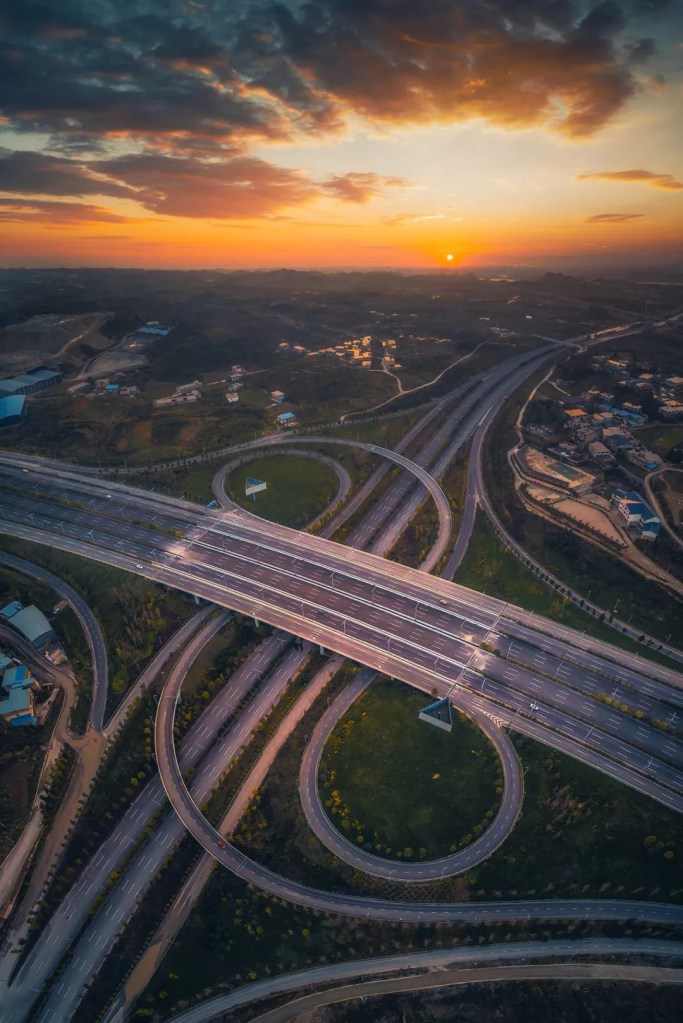
Left-turning slip roads are composed of two loop and two #7 type
(photo: 天祺)
Or a pair of piercing eyes staring into the universe.
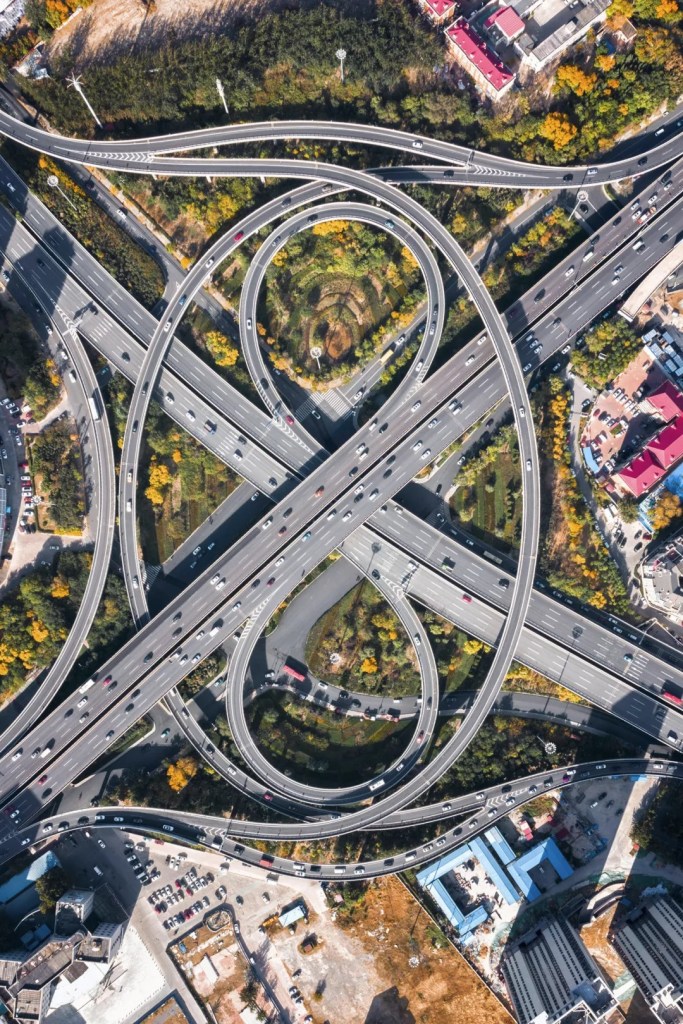
Left-turning slip roads are composed of two loop and two #7 type
(photo: 李源)
Though there are many practical challenges in building interchanges, nothing can stop engineers from being creative.
Just take a look at the intersection of two urban expressways squeezed in the choking gap between Sichuan-Guizhou Railway and Qianling Mountain. Too crowded for a four-way interchange? How about splitting it into two three-way interchanges to fit?
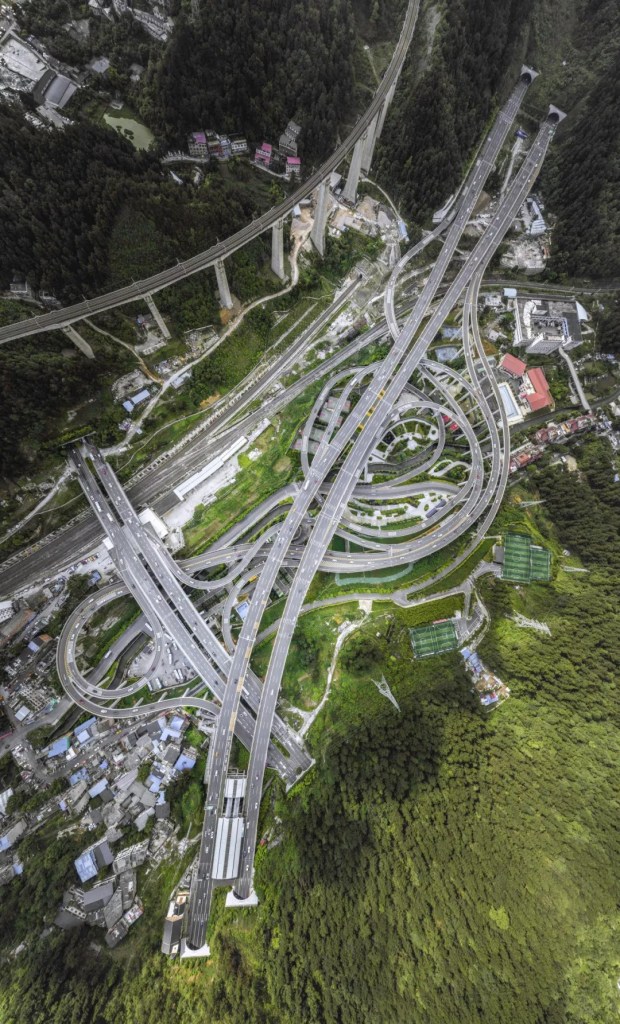
The two positive lines at the bottom are fully connected by a trumpet interchange on the left and a full Y-interchange on the right
(photo: 李源)
Yet it is still not as innovative as the Egongyan Interchange in Chongqing, in which the ahead-of-time configuration of left-turning slip roads allows them to simultaneously handle the right turns.
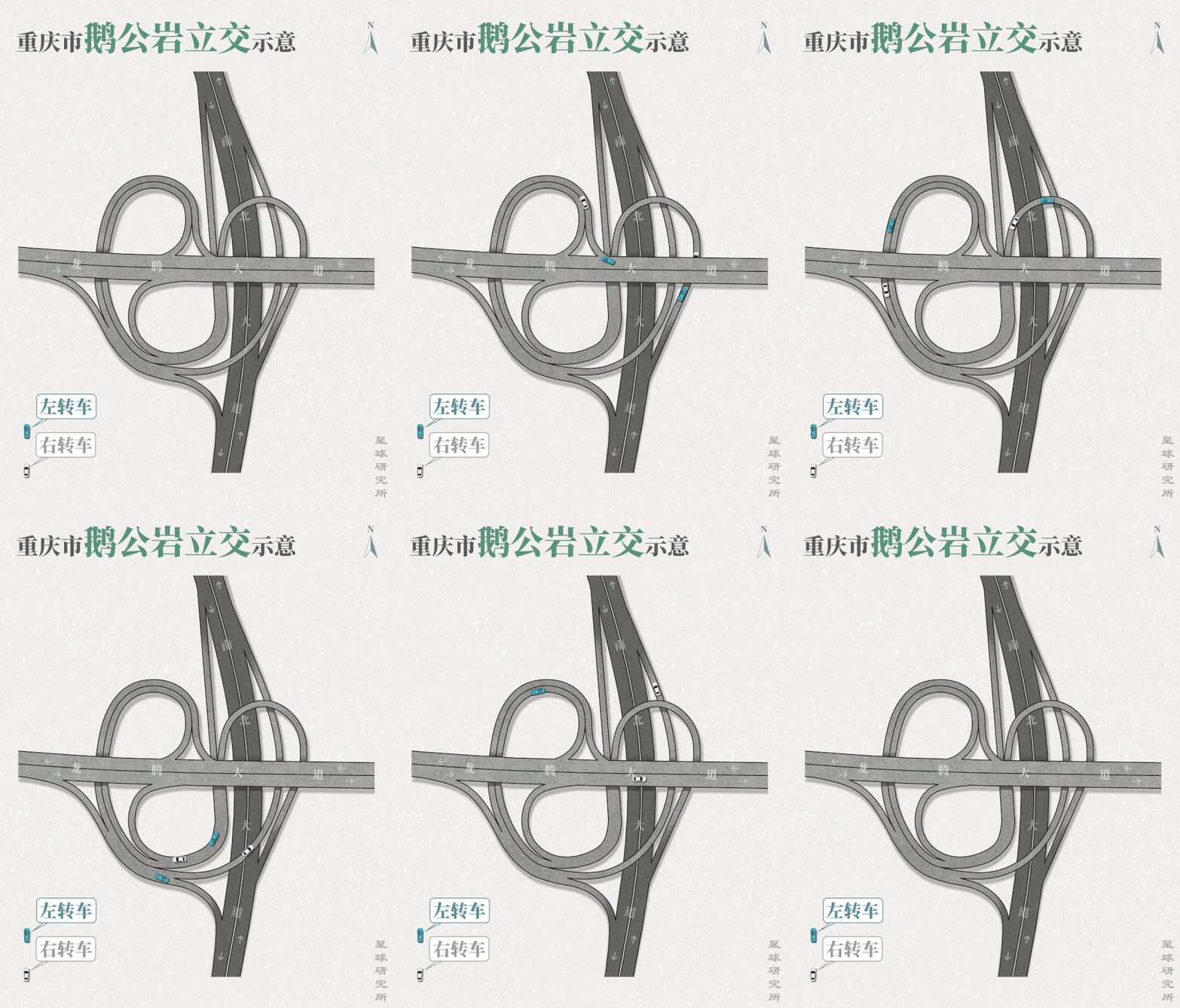
(diagram: 郑伯容&陈思琦, Institute for Planets)
The splendid curves of this interchange is a classic representation of artistic engineering.
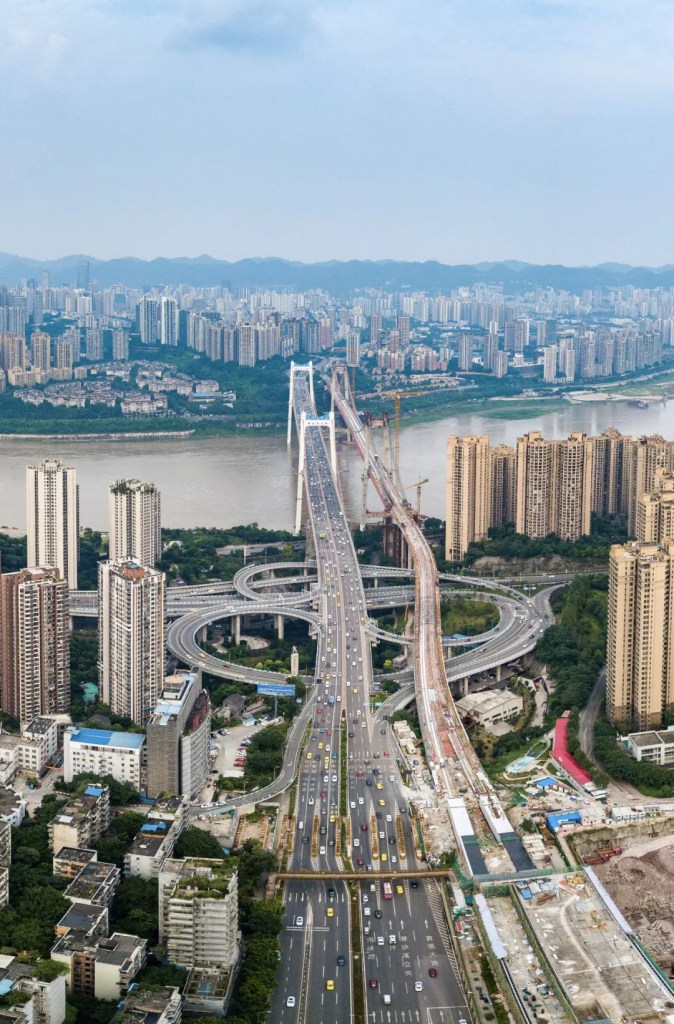
Connected to the Ergongyan Yantze River Bridge, the slip roads are 58 metres above ground
The bridge under construction on the right is for the Eogongyan Railway
(photo: 李昌华)
Thanks to these creative engineers, interchanges are doing a graceful dance even with cuffed legs, and their true potential is still far from exhaustion.

Always striving for perfection
In a busy city, urban road networks have to handle not only three- or four-leg intersections, but also five-leg or even more complicated intersections. The simplest and prettiest solution would be to use roundabouts.
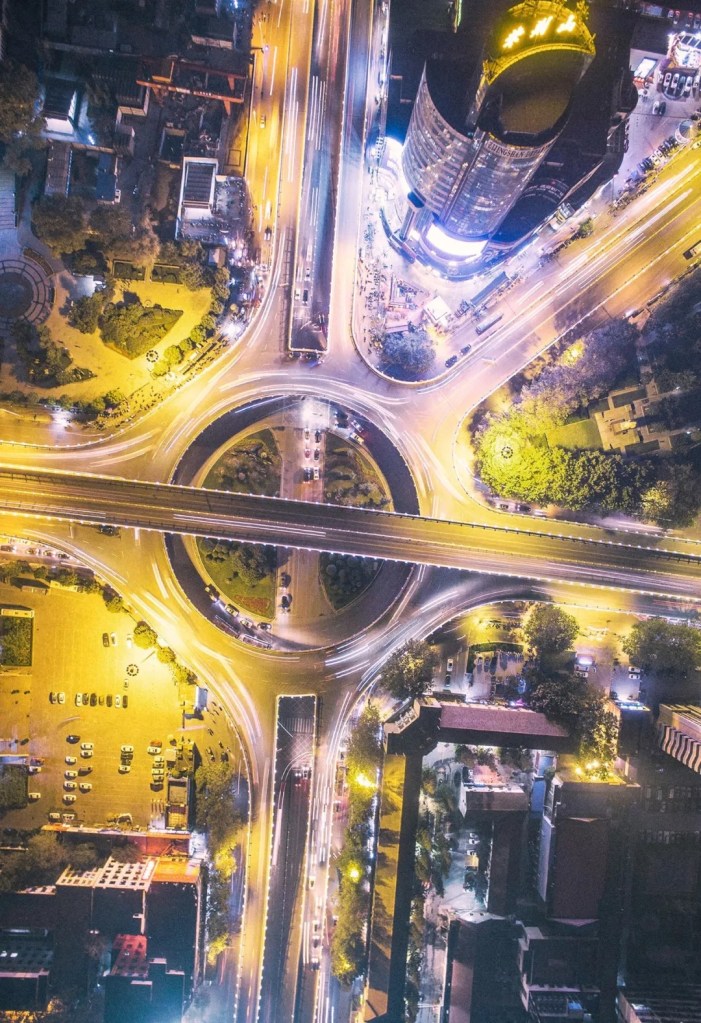
The roundabout is connected to five traffic directions
(photo: 焦潇翔)
Roundabouts are most commonly used when intersecting roads are classified into major and minor lines. While all traffic movements for minor lines are handled by the roundabout, major lines can simply fly over it or traverse underneath. This separation ensures uninterrupted through traffic.
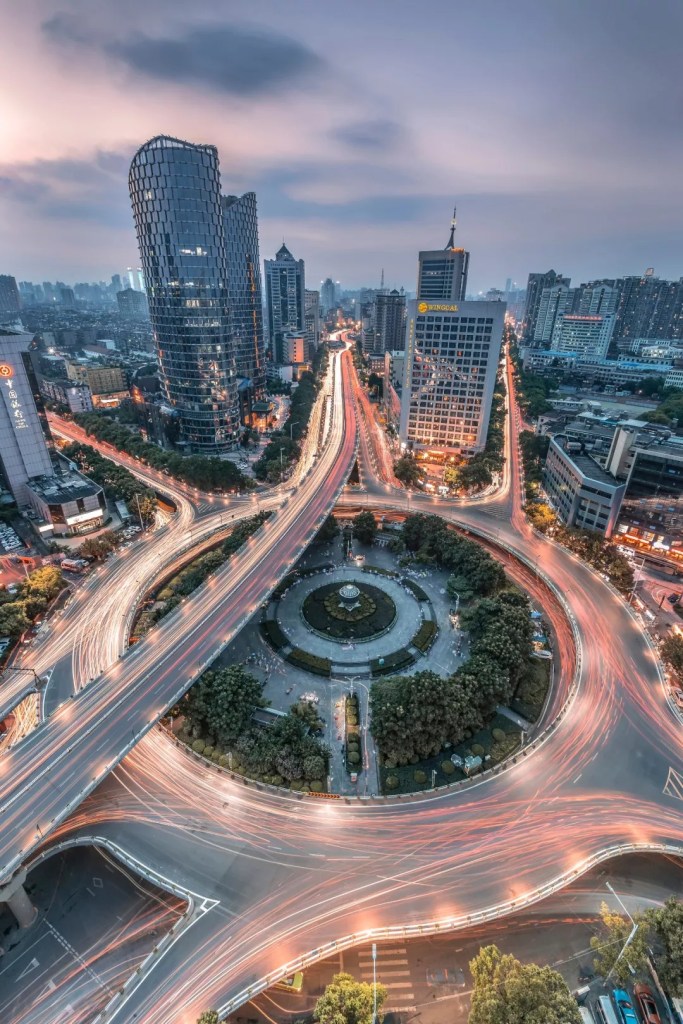
(photo: 廖昊)
But the disadvantages of roundabouts are also obvious. First, they are huge, with diameters easily reaching several dozen metres. Second, weaving of vehicles from all directions severely hampers the traffic flow. During peak hours, entrances and exits are easily blocked, which turns the entire roundabout into a deadlock.
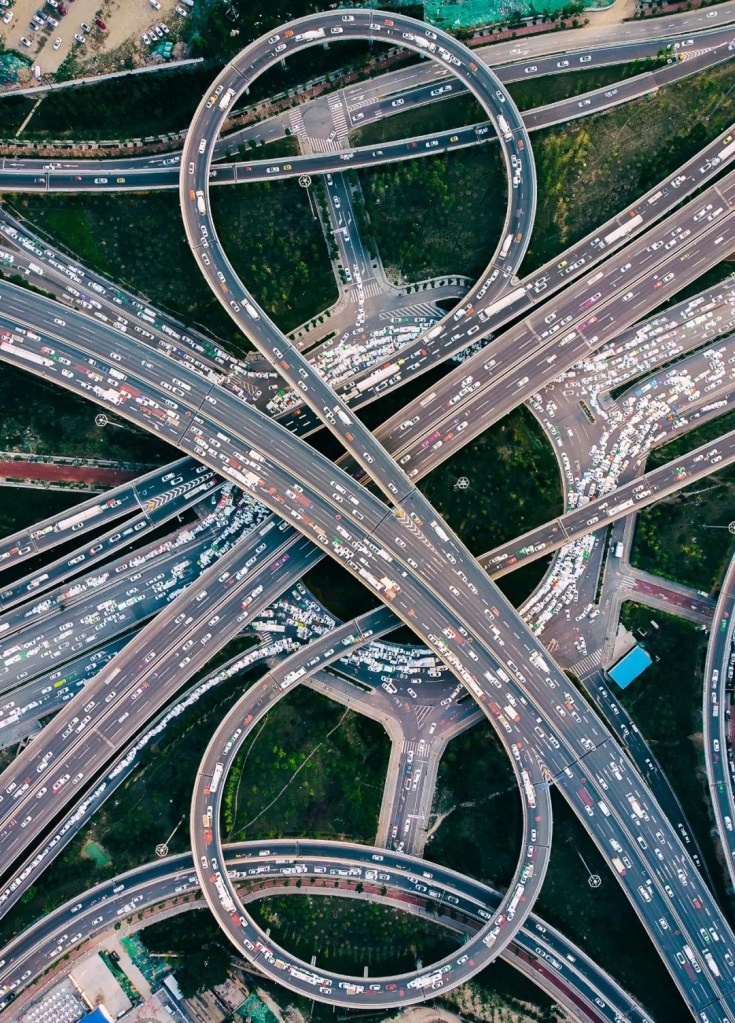
Congested roundabout during peak hour
(photo: 风逸)
A combination approach was introduced to upgrade the roundabout system, where lines with higher traffic flow are supplemented with additional slip roads.
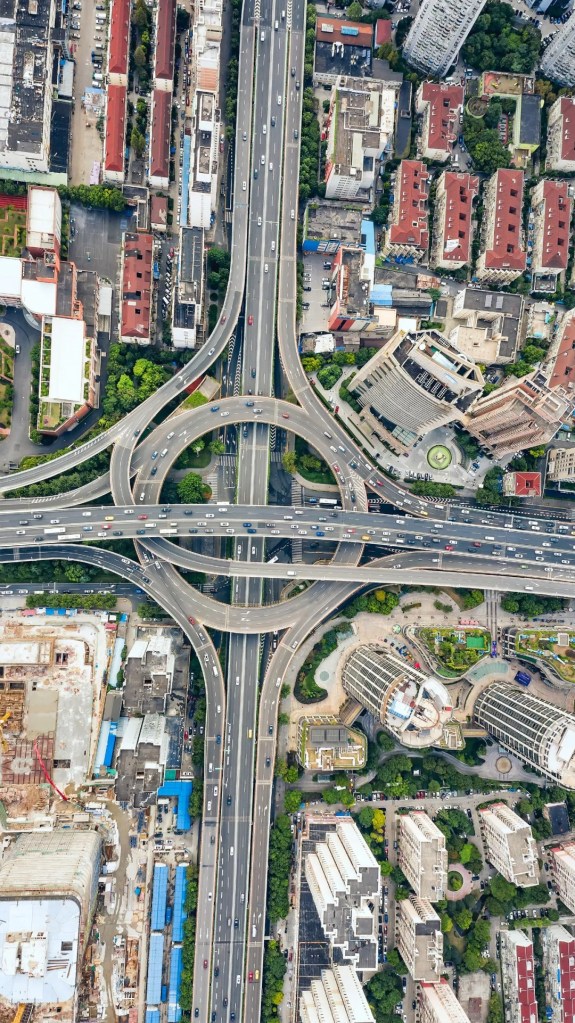
Vehicles coming down from the top lane turn left through a #7 slip road instead of the roundabout
(photo: 张扬的小强)
As traffic flow increases, more slip roads are added to promptly release pressure on the roundabout. In some cases, an additional full interchange is stacked on top of the roundabout to guarantee a smooth ride through the intersection.

This intersection consists of a multi-leg roundabout and a four-way interchange comprised of four #1 slip roads
(photo: 方飞)
On the other hand, if all intersection lines have the same priority for traffic flow, struggling roundabouts will have to be completely replaced by slip roads. However, relying only on slip roads while promising full connection among multiple directions is impractical owing to the huge cost, which rapidly rises with structural complexity. The majority of existing interchanges, specifically semi-interchanges, are therefore products of tough decisions and even reluctant compromises.
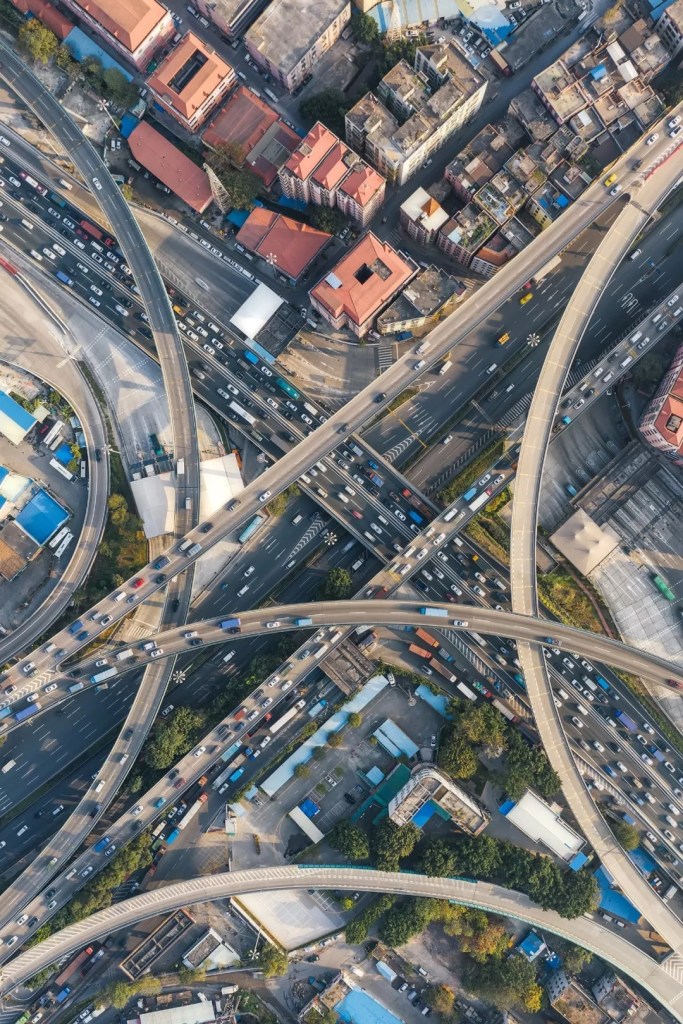
An example of semi-interchange
(photo: Patrick wong)
Nonetheless, the dazzling charm radiating from their majestic appearances and intricate structures deserves as much admiration as for their flawlessly symmetrical relatives.
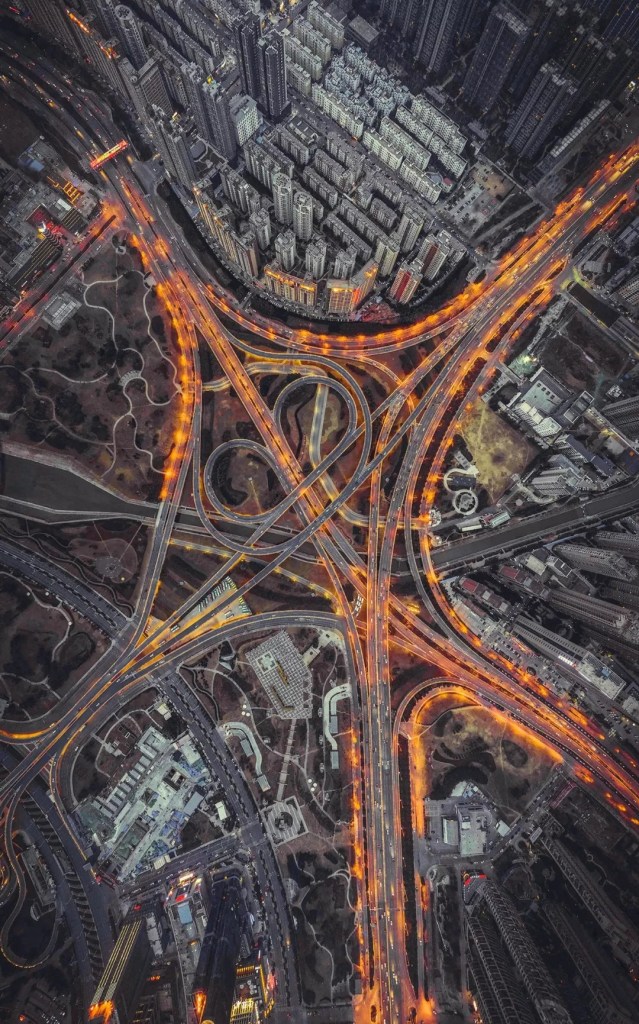
This enormous interchange occupies a total area of 280,000 square metres
(photo: 李源)
In 2017, the Huangjuewan Interchange in Chongqing was finally completed after 8 years of construction and retrofitting. Interconnecting 5 directions with 15 slip roads and separating the intertwining lanes into 5 grades, this famous hub-style interchange links up four major economic regions, namely the Monument to People’s Liberation, Jiangbeizui, Tanzishi and Jiangnan New Town.
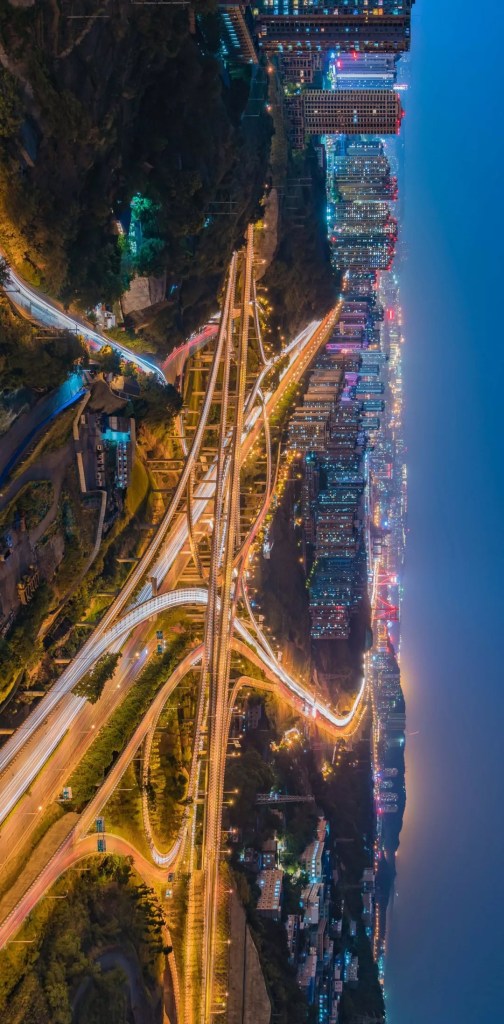
It has an intricate design despite being a semi-interchange
(photo: 杨大川)
The price for such impressive interconnectivity is the colossal scale of land use. Despite the careful optimisation for each of the entrance and exit, the dauntingly complex structure is still intimidating to visiting drivers.
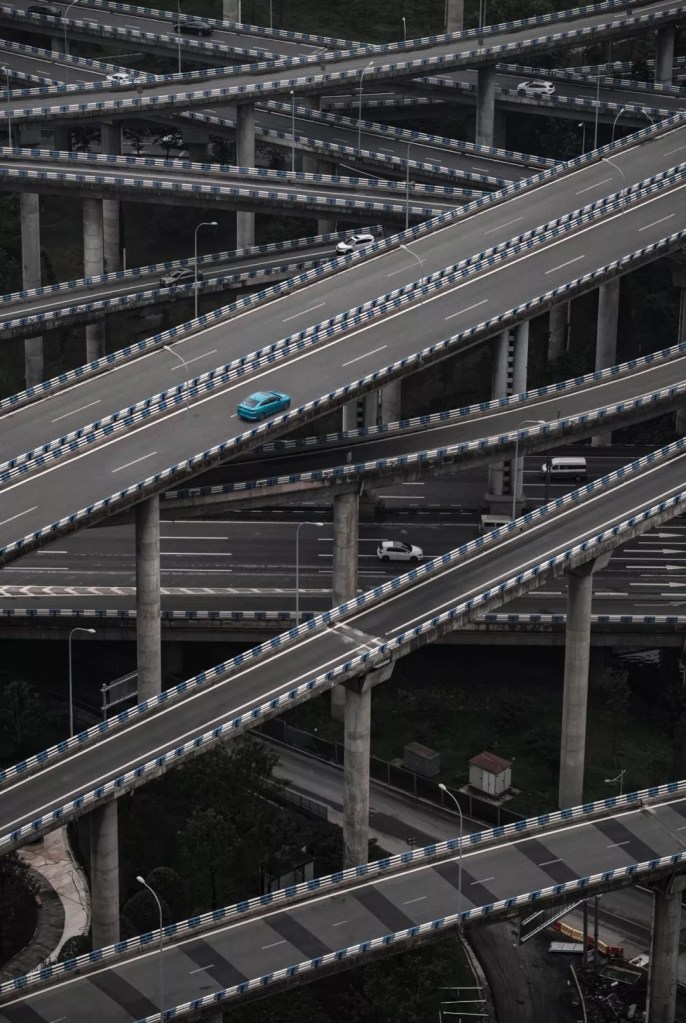
(photo: 东风风神奕炫)
Like all other interchanges presented above, the Huangjuewan Interchange is not without flaws, but it indispensable role in running the vibrant city is unquestionable.
Today, interchanges are everywhere in China. The total number of operating interchanges has now reached above 5000. In Beijing alone, there are more than 400 of them scattered across the city, serving the travel needs of tens of millions of passengers at critical junctions.

2nd (二环), 3rd (三环), 4th (四环), 5th (五环) and 6th Ring Road (六环)
(diagram: 陈思琦&郑伯容, Institute for Planets)
Interchanges to modern cities is almost like breathing air to us. They seem to be everywhere, and we can hardly live without them. They have also introduced a whole new perspective of urban aesthetics.
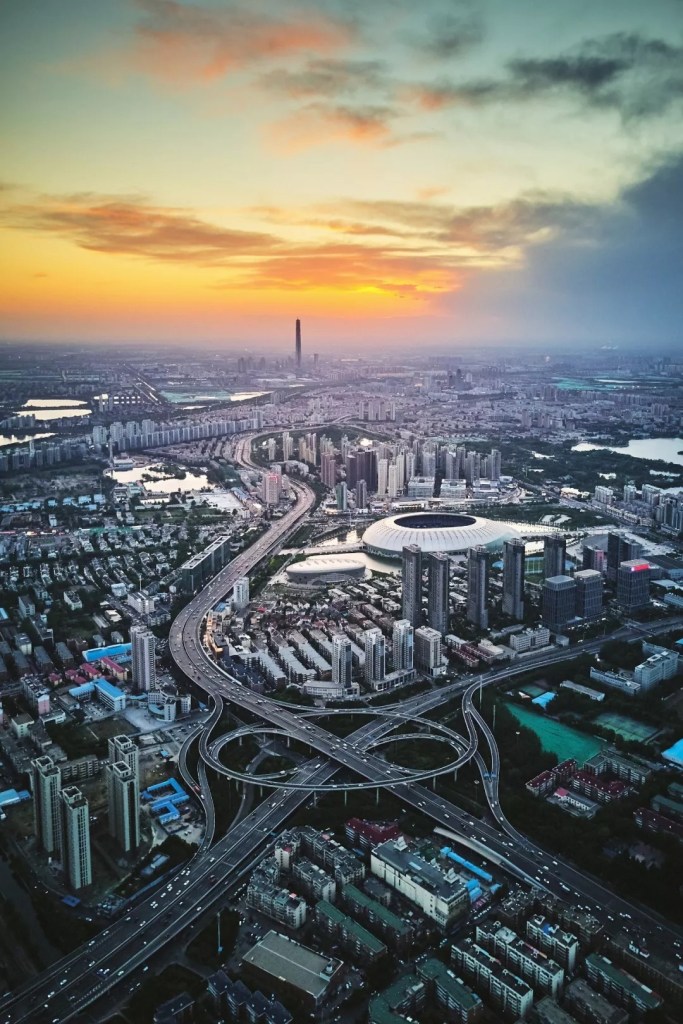
(photo: 祝昭飞 (Feizz))
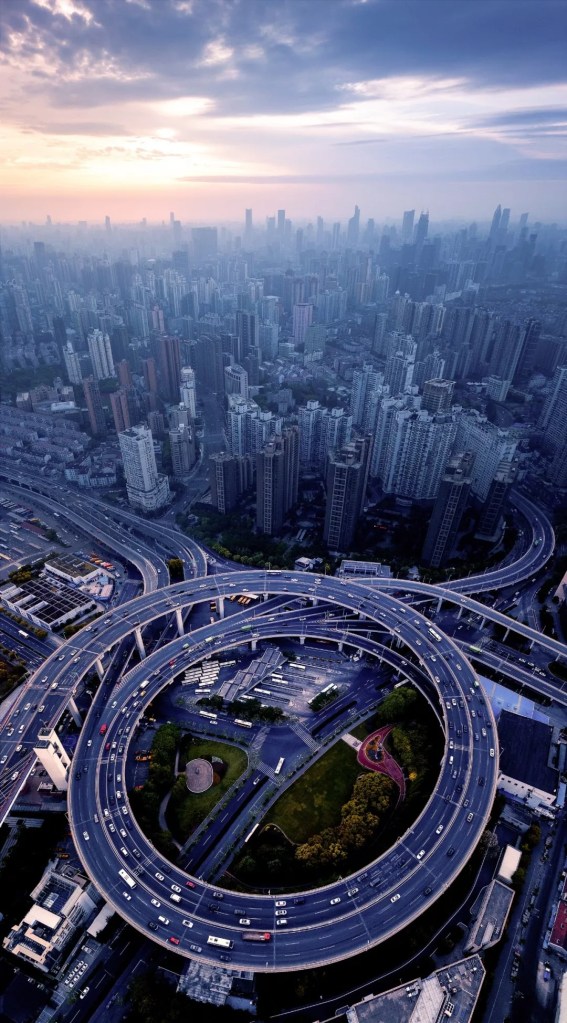
Throughout the history of interchanges, engineers have painted numerous vivid worlds of geometry using their boundless creativity. It is a great pity that practical considerations including traffic efficiency, construction cost, minimalistic architecture and land use are holding their hands back. Perhaps it will take generations before interchanges can attain perfection, assuming there is such.
But looking at these ‘imperfect’ creations does make one think again. Do such constraints and regrets not illustrate exactly the irresistible charm of engineering?
Production Team
Text: 桢公子
Editing: 王昆
Photos: 余宽&刘白
Design: 郑伯容&赵榜
Maps: 陈思琦
Review: 王朝阳
References
[1]刘旭吾. 互通式立交线形设计与施工[M]. 人民交通出版社, 1997.
[2]王伯惠. 道路立交工程[M]. 人民交通出版社, 1992.
[3]贺栓海. 道路立交的规划与设计[M]. 人民交通出版社, 1994.
[4]万明坤等. 桥梁漫笔[M]. 中国铁道出版社, 2015.
[5]邵春福. 城市交通设计[M]. 北京交通大学出版社, 2016
[6]高速公路丛书编委会. 高速公路立交工程[M]. 人民交通出版社, 2001.
[7]乔翔等. 公路立交规划与设计实务[M]. 人民交通出版社, 2001.
[8]李海泉. 北京立交桥[M]. 北京出版社, 1996.
… The End …

星球研究所
一群国家地理控,专注于探索极致风光
 K in the clouds